
If you are an HR or operations leader evaluating your employee experience strategy this year, you’ve likely noticed a distinct shift in the air. The playbook that worked three years ago—relying on surface-level perks, weekly pulse surveys, and isolated well-being initiatives—is failing to move the needle.
In 2026, the global workforce is no longer asking, "How can I grow here?" Instead, against a backdrop of rapid technological shifts and market adjustments, employees are asking a fundamentally different question: "Is this company stable, and will it succeed?"
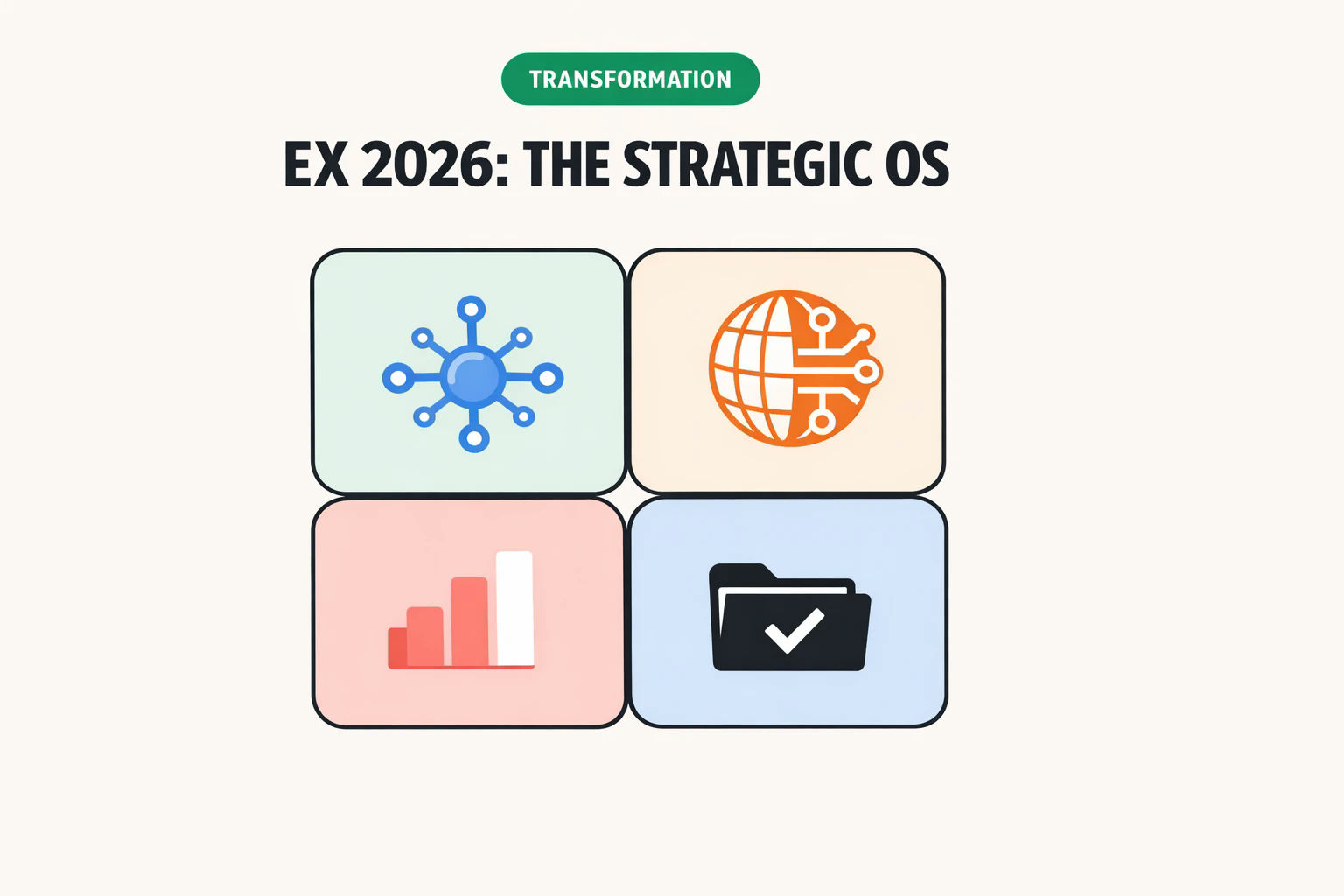
This shift marks the definitive end of the "engagement-led" era of HR. We are now operating in a "transformation-led" environment. Leading organizations are no longer treating employee experience (EX) as a collection of disjointed HR initiatives. They are treating it as a unified, holistic operating system.
To secure budget, drive retention, and build genuine trust across hybrid and global workforces, your EX framework must bridge the gap between high-level leadership confidence and the granular, friction-free daily administration that proves your company has its house in order.
The 2026 Pivot: Why 'Engagement' as We Knew It Is Dead
For years, employee engagement strategies focused heavily on fostering a sense of belonging through office perks and social connection. While belonging remains important, the primary catalyst for workforce motivation has fundamentally changed.
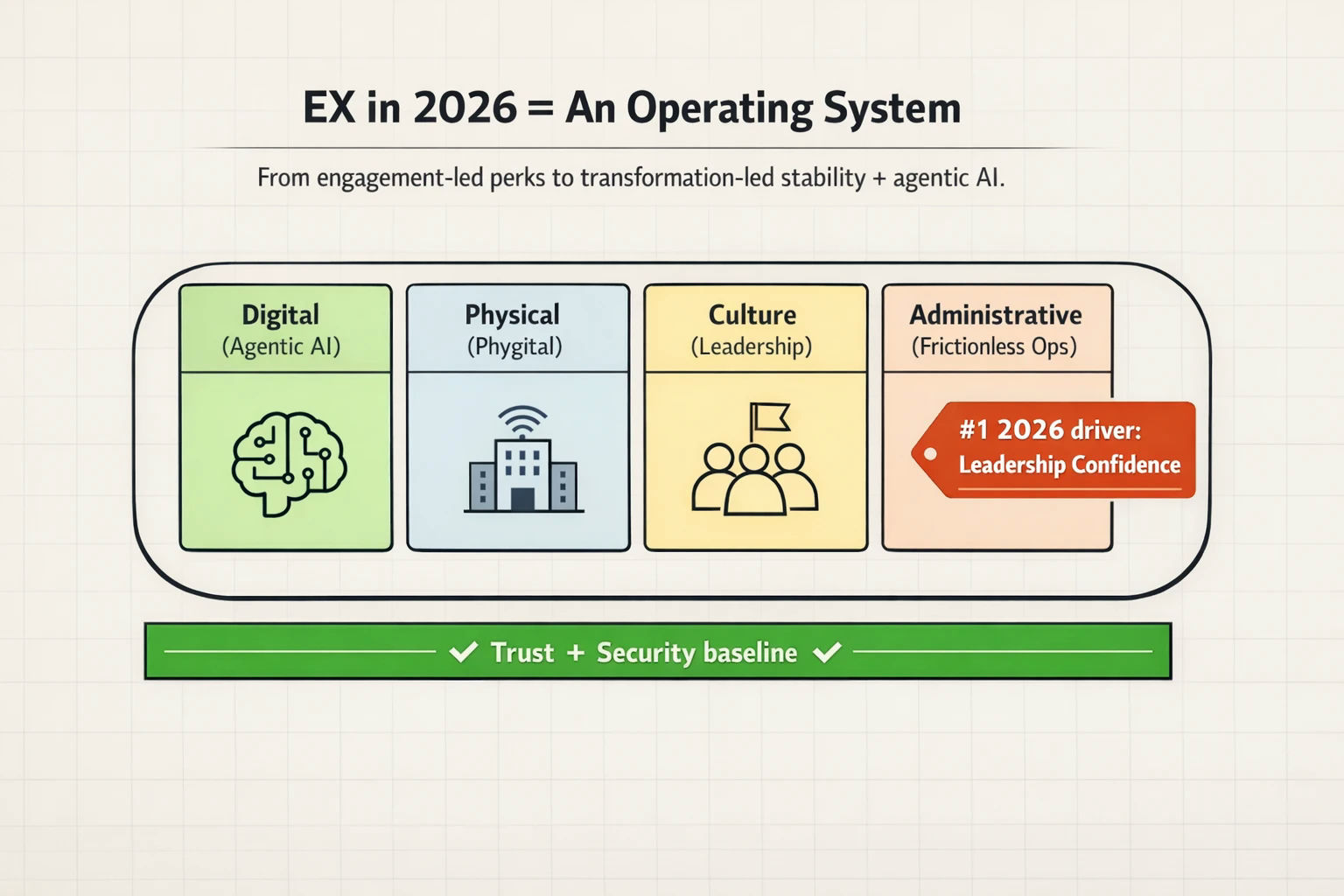
According to the Perceptyx 2026 Employee Experience Trends Report, the number one driver of engagement today is Confidence in Leadership and Strategic Visibility.
Employees want to know that the executives steering the ship have a clear, data-backed plan. They expect their daily tools to reflect that same level of competence. When an employee logs in and has to navigate three different platforms just to find their customized benefit options, request expense reimbursement, or read a vital company update in their native language, that friction erodes confidence.
To solve this, a modern EX strategy must move beyond theoretical tech trends and isolated operational fixes. You need a master framework.
The 4 Pillars of the 2026 EX Master Framework
A truly resilient, 2026-ready EX framework requires balancing four distinct pillars. Many legacy platforms or consultative blueprints focus heavily on one or two, leaving critical gaps in your workforce's daily experience.
1. Digital: The Era of Agentic AI
We've moved past conversational chatbots that merely point employees to a PDF. The digital pillar of 2026 relies on Agentic AI—artificial intelligence that actually executes tasks. Whether it’s auto-onboarding a new hire, proactively nudging a manager to recognize a team member's anniversary, or allowing employees to instantly curate their flexible benefit plans from thousands of options, your digital workspace must act as a seamless, multilingual hub that connects distributed teams instantly.
2. Physical & Phygital: Hybrid Resilience
Designing for connection rather than mere office occupancy is the hallmark of modern physical EX. Your framework must support a seamless "phygital" reality where a remote worker in Berlin feels the exact same 360-degree recognition and visibility as an employee sitting at headquarters. This requires a centralized internal communication system that breaks down geographic and linguistic barriers.
3. Culture & Leadership: Rebuilding Human Connection
You cannot automate culture, but you can build systems that facilitate it. Rebuilding the boss-employee relationship requires shifting from annual reviews to continuous, visible appreciation. A culture of employee recognition is a proven strategic driver of business success. When leaders actively and publicly acknowledge achievements, it feeds directly into that crucial metric: confidence in leadership.
4. Administrative: The Secret Pillar of Trust
This is the most critical and often overlooked component of the 2026 framework. Administrative excellence—frictionless compliance, seamless expense reimbursement, and flawless record-keeping—is no longer just "back-office HR operations." It is the baseline of employee trust. If your company cannot reliably track a holiday-pay record, why should an employee trust your five-year growth strategy?
The Operational Layer: When Compliance Becomes an Experience
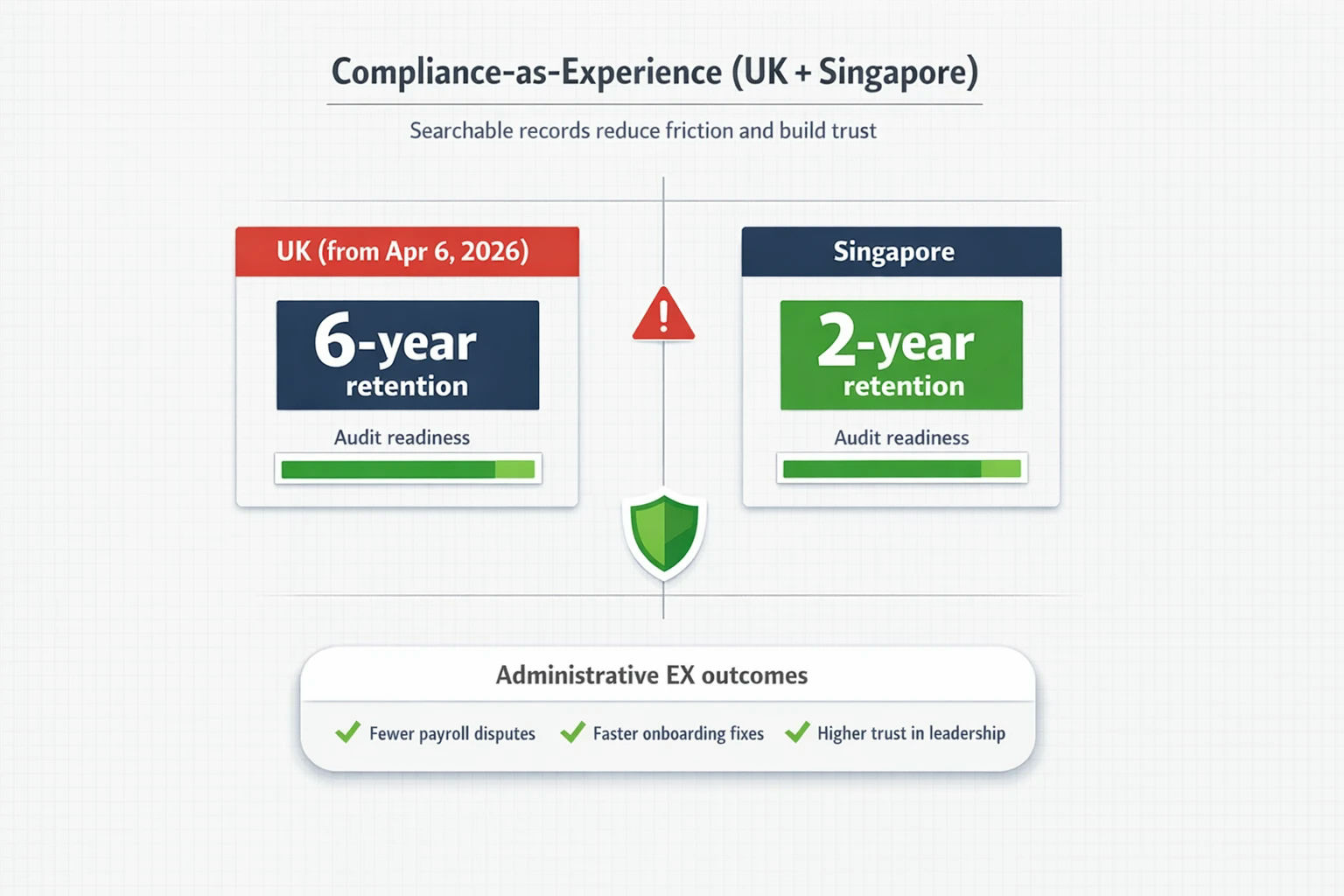
Let’s look at the immediate realities facing HR operations right now. As of last week, on April 6, 2026, the UK Employment Rights Act 2025 officially mandated a strict six-year retention duty for holiday-pay records. Failure to comply is now a criminal offense. Meanwhile, the Ministry of Manpower (MOM) in Singapore heavily enforces its statutory two-year retention requirements.
Historically, companies treated these mandates as isolated, dry compliance issues. In a 2026 framework, "Searchable Compliance" is a core EX strategy.
When your administrative layer is scattered across spreadsheets and legacy payroll tools, HR spends hours hunting down data instead of engaging with people. By integrating robust data retention and secure, localized HR system integrations (such as BambooHR or Runa) into your core EX platform, you achieve two things:
- You mitigate massive legal and financial risk.
- You provide employees with transparent, frictionless access to their own data, reinforcing their feeling of security.
You transform a mandatory legal checkbox into a visible trust-builder.
EX vs. CX: The Unified Experience ROI
Securing the budget for an all-in-one EX platform requires speaking the language of the C-suite: Return on Investment (ROI).
The narrative that employee experience is a "soft" metric is mathematically false. According to joint research from Harvard Business Review and Salesforce, companies leading in employee experience grow their revenue twice as fast as laggards and yield 25% higher profit margins.
Why? Because internal record accuracy, high motivation through personalized benefits, and a culture of continuous recognition prevent external customer churn. When your employees are not battling internal system friction, they focus entirely on delivering exceptional client outcomes.
Implementation Checklist: Transitioning Your Framework
Moving from an outdated model to a transformation-led EX operating system doesn’t have to require ripping out your entire tech stack overnight. Follow this structured maturity path:
- Audit the Administrative Baseline: Ensure your platform natively handles current 2026 global compliance mandates (like the UK’s 6-year holiday-pay retention). Connect these back-office functions to your front-end employee portals.
- Unify the Communications Hub: Implement a multilingual intranet or internal comms tool that guarantees every employee, regardless of country, receives strategic updates simultaneously.
- Deploy Personalized Benefits: Move away from one-size-fits-all perks. Implement a flexible system where employees can select from thousands of global and localized benefit options that match their actual life needs.
- Institutionalize 360° Recognition: Introduce systems where peer-to-peer and top-down appreciation are visible, frequent, and tied to company values.
- Activate Agentic AI: Layer in AI automations that actively manage budget reporting, nudge managers with predictive engagement analytics, and guide employees through their benefits queries seamlessly.
Your Next Steps Toward a 2026-Ready Organization
Rethinking your Employee Experience framework is no longer an optional luxury—it is the foundational requirement for business stability and growth in 2026. As you evaluate solutions to modernize your workplace, prioritize platforms that don't just offer isolated features, but deliver a complete ecosystem.
When you seamlessly combine clear internal communication, meaningful recognition, highly personalized benefits, and bulletproof administrative compliance, you give your workforce the ultimate asset: profound confidence in the future of your company.
Ready to see how your current strategy measures up? Evaluate your organization against the four pillars and begin transforming your operational friction into an exceptional daily experience today.