
Most HR leaders heading into 2026 are asking the same question about their employee experience strategy: is it still doing what it needs to do? For many organisations, the honest answer is no. Surface-level perks, occasional pulse surveys, and well-being initiatives that sit in isolation from each other are no longer enough on their own to drive retention or genuine engagement.
What employees are looking for has shifted alongside the changes in how we work. In a workforce navigating hybrid arrangements, rapid technological change, and ongoing economic pressure, the basics matter more than ever: clear internal communication, recognition that lands consistently, and benefits that genuinely fit individual lives. When those foundations are not in place, no one-off initiative will close the gap.
[cta:cta-1-experience]
This is why a growing number of organisations are moving away from fragmented HR tools towards integrated platforms that combine internal communication, employee recognition, and personalised benefits in one place. A modern employee experience framework needs to connect the strategic ambitions of leadership with the daily reality employees actually experience. The four pillars set out below describe how to think about that framework, and what to look for when you evaluate the platforms that support it.
The 2026 pivot: from employee engagement to employee experience
For years, employee engagement strategies focused heavily on belonging through office perks and social initiatives. Belonging still matters. But it is no longer the only foundation, and in many organisations it is no longer the most pressing one.
Recent research consistently points to clear communication, consistent recognition, and personalised benefits as the operational drivers of engagement in distributed environments.
Employees expect their organisations to have a clear plan, and they expect their daily tools to reflect that same level of competence. When an employee has to navigate three different platforms to find their benefit options, request expense reimbursement, or read a vital company update in their preferred language, that friction erodes confidence in the wider organisation. A modern EX strategy needs a master framework that addresses this directly.
The 4 pillars of the 2026 EX master framework
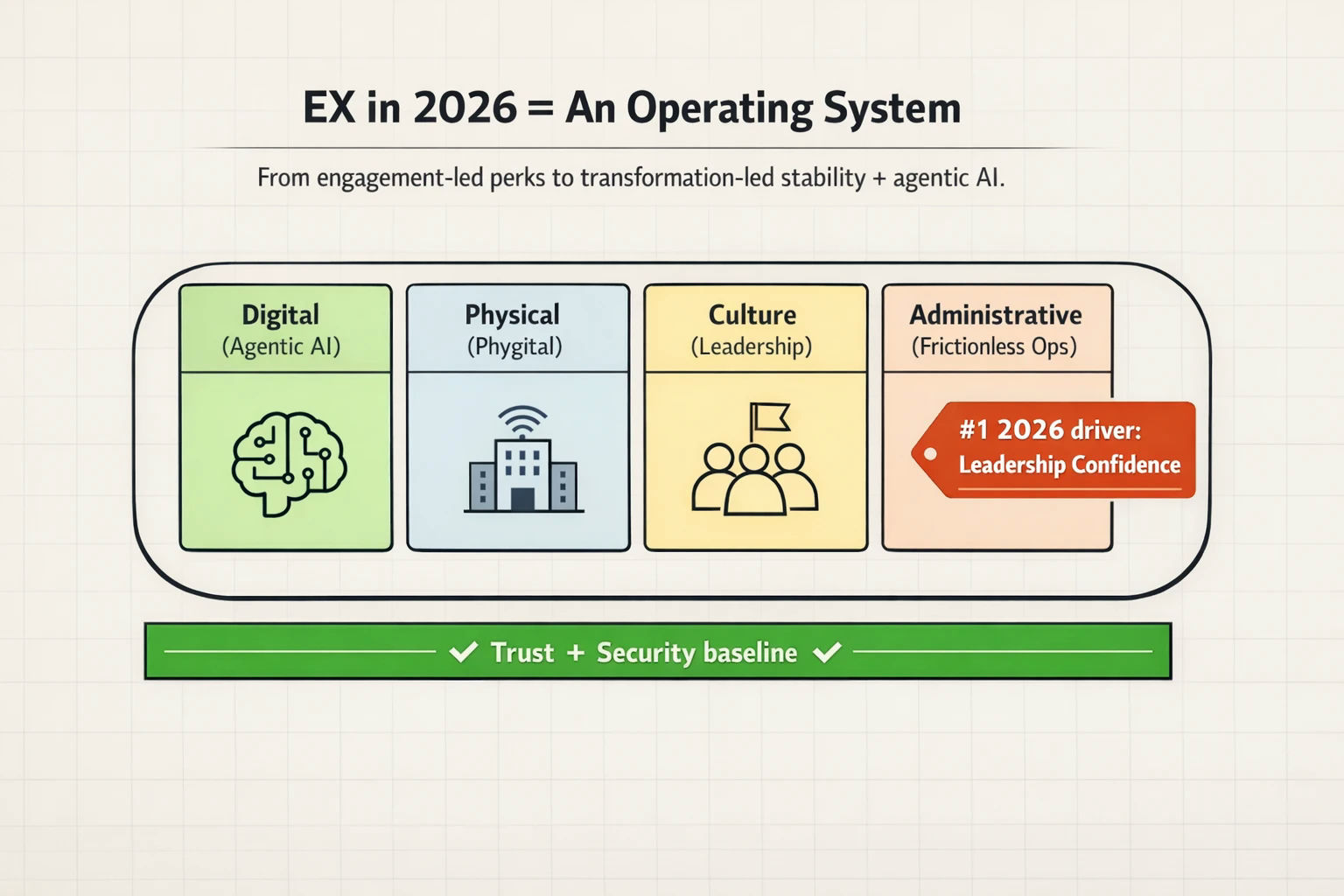
A resilient, 2026-ready EX framework balances four connected pillars. Many legacy platforms or consultative blueprints focus heavily on one or two, leaving real gaps in the day-to-day experience.
1. Digital: practical AI and automation
The digital pillar of 2026 is moving past chatbots that simply point employees to a PDF. Useful AI in HR is not about replacing human judgement; it is about reducing the administrative burden that gets in the way of meaningful work.
In practice, this looks like AI-assisted text and image generation that helps HR teams produce internal communications faster, automated receipt scanning that takes the friction out of expense reimbursement, and an intranet chatbot trained on company documents that can answer routine policy questions instantly. AI-supported recognition rules also help reinforce the behaviours an organisation wants to encourage. Broader predictive features, where AI surfaces early signals of disengagement or turnover risk, are still developing across the market and worth treating as roadmap features rather than current requirements when evaluating platforms.
2. Physical and phygital: hybrid resilience
Designing for connection rather than mere office occupancy is the hallmark of modern physical EX. A framework needs to support a phygital reality where a remote worker in Berlin feels the same level of recognition and visibility as a colleague at headquarters.
This requires a centralised internal communication system that breaks down geographic and linguistic barriers. In practice, that means a mobile-first platform that reaches deskless and remote employees, including those without a company email address, with multilingual support, segmentation by team or location, and instant push notifications. An interface available in multiple languages, combined with content HR can create in the languages employees actually use, ensures every team consumes important updates in a way they understand.
3. Culture and leadership: rebuilding human connection
You cannot automate culture, but you can build systems that facilitate it. Rebuilding the relationship between managers and their teams in distributed organisations requires shifting from annual reviews to continuous, visible appreciation. A culture of employee recognition is one of the most consistent strategic drivers of business performance.
A 360-degree recognition system lets colleagues at every level appreciate one another, not just top-down, but in every direction. Personal messages, points, and rewards redeemable in a benefits shop add a tangible layer of motivation. Public visibility through a shared recognition feed turns individual moments of appreciation into a cultural signal across the organisation, reinforcing the values and behaviours leadership wants to encourage.
4. Administrative: the foundation of trust
This is the most overlooked component of the 2026 framework. Administrative excellence, including frictionless expense reimbursement, transparent benefit administration, and reliable record-keeping, is no longer just back-office HR operations. It is the baseline of employee trust. If an organisation cannot reliably process an expense claim or answer a basic benefits question, employees have less reason to trust the wider strategy.
In practice, this means automating the workflows that take up disproportionate HR and finance time, giving employees self-service access to their own benefits and budgets, and providing secure feedback channels that meet regulatory requirements such as the EU Whistleblowing Directive.
The operational layer: when compliance becomes an experience
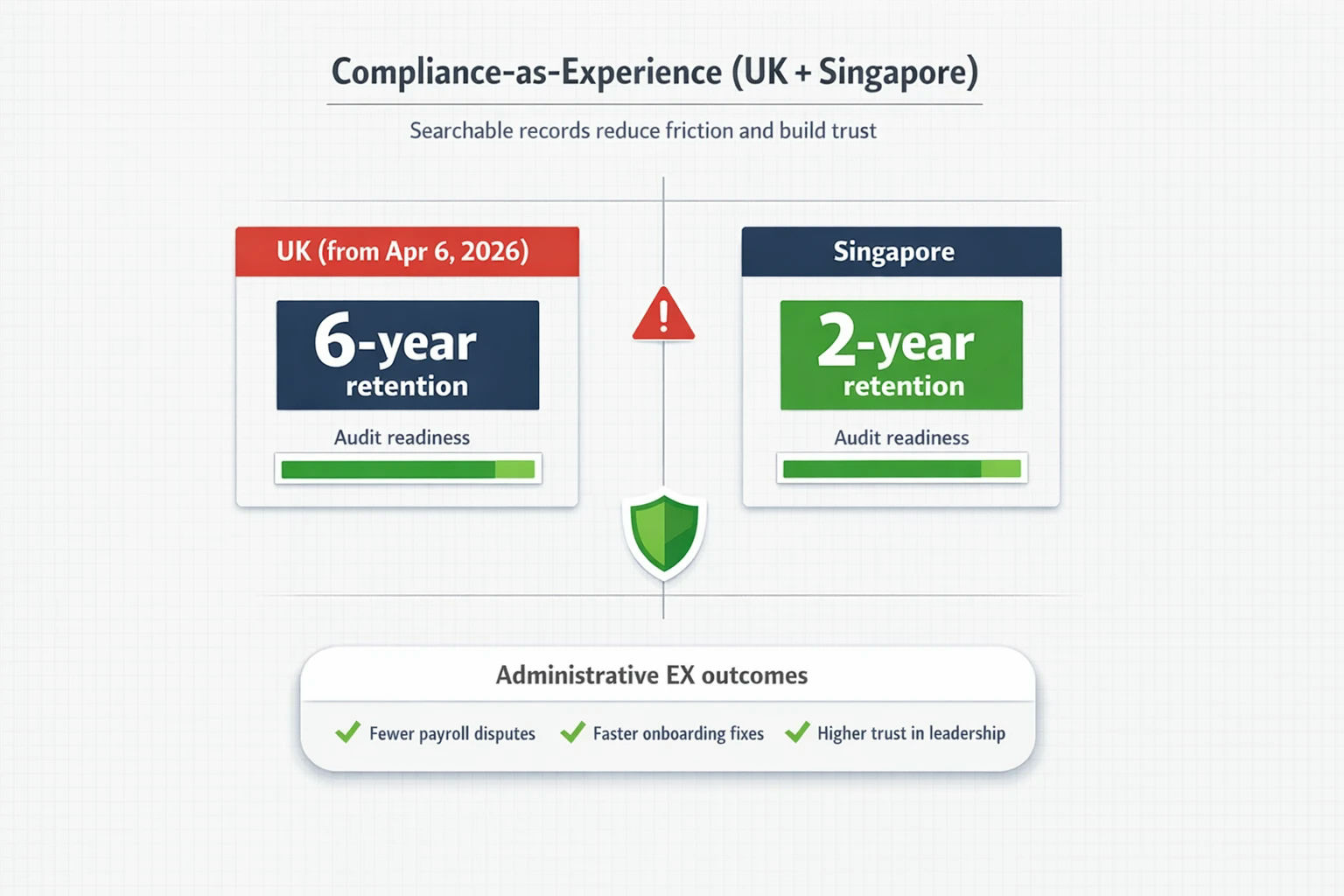
The regulatory environment makes administrative reliability more important than ever. From 6 April 2026, the UK Employment Rights Act 2025 introduced a new requirement for employers to keep adequate records of annual leave and holiday pay for at least six years, with non-compliance treated as a criminal offence. This is one of several shifts that move administrative reliability from a back-office concern to a daily employee experience issue.
Historically, organisations treated compliance as an isolated technical topic. In a 2026 framework, however, every interaction an employee has with HR systems, whether submitting an expense claim, accessing benefits information, or raising a confidential concern, contributes to or erodes trust in the organisation. When the administrative layer is scattered across spreadsheets and legacy tools, HR spends hours hunting down information instead of working with people.
Bringing administrative experience onto a connected platform achieves two things in parallel. It reduces operational risk and overhead, and it gives employees transparent access to the parts of the organisation that affect their day-to-day work. Integration with existing HR and payroll systems, via API or structured exports depending on the systems already in place, keeps eligibility, joiners, leavers, and benefit changes in sync without duplicating effort. A mandatory legal checkbox becomes a visible trust-builder rather than a hidden source of friction.
[cta:cta-2-experience]
How employee experience drives customer experience
Securing the budget for an integrated EX platform usually requires translating the conversation into language the C-suite responds to: return on investment.
The narrative that employee experience is a soft metric is becoming harder to defend. Engagement is consistently associated with stronger commercial outcomes. Gallup's 2024 meta-analysis found that the most engaged teams have 21% lower turnover in high-turnover organisations and 51% lower turnover in low-turnover ones. The mechanism is straightforward. When employees can communicate clearly, feel recognised for their work, and have access to benefits that match their lives, they focus on customer outcomes rather than internal friction.
For HR leaders building a business case, the most useful figures are usually those tied to retention. Replacing an employee typically costs between six months and twice their annual salary, depending on role and seniority. A platform that measurably reduces turnover pays for itself relatively quickly, and integrated EX investment compounds that effect across communication, recognition, and employee benefits.
[cta:cta-3-experience]
Implementation checklist: transitioning your framework
Moving from a fragmented model to an integrated EX framework does not require replacing your entire technology stack overnight. A structured maturity path works for most organisations.
- Audit the administrative baseline: Identify where current tools create friction for both employees and HR teams, particularly in expense reimbursement, benefit communication, and feedback channels. The areas with the highest friction are usually the highest-value first steps.
- Unify the communications hub: Implement an internal communications tool that reaches every employee, including those without a company email address, with multilingual support and mobile push notifications.
- Deploy personalised benefits: Move away from one-size-fits-all perks. Implement a flexible model where employees can select from a wide catalogue of localised benefit options that match their actual lives.
- Institutionalise 360-degree recognition: Introduce systems where peer-to-peer and top-down appreciation are visible, frequent, and tied to company values. Consistency depends on structure, not on individual managers remembering.
- Add AI automation where it removes administrative burden today: Use AI-assisted text and image generation, automated receipt scanning, and an intranet chatbot for routine policy questions. Treat predictive engagement analytics as a roadmap consideration rather than a current requirement when evaluating platforms.
Your next steps towards a 2026-ready organisation
Rethinking your employee experience framework is no longer an optional luxury. It is increasingly a foundational requirement for retention and engagement in 2026. As you evaluate platforms to modernise your workplace, prioritise solutions that bring internal communication, recognition, personalised benefits, and reliable administration into a single ecosystem rather than a stack of point tools.
When clear internal communication, meaningful recognition, personalised benefits, and frictionless administration come together, your workforce gets something simple: an organisation that visibly works for them.
If you would like to see how MELP supports this kind of framework, request a demo or explore the pricing options to find the plan that fits your team.
[cta:cta-4-experience]