

If you are mapping out your organisation's people strategy for the next budget cycle, the chances are you have already noticed that some of the older approaches to employee experience are losing traction. A few years ago, HR leaders focused heavily on emotional engagement, building a sense of belonging through workplace perks and social initiatives. These still have a place, but they are no longer the main lever.
In 2026, the picture has shifted. Employees are not asking for another team breakfast or branded tote bag. They want a workplace where the basics work properly, where they have the tools to do their jobs without friction, and where they can choose benefits that genuinely fit their lives. A modern EX strategy treats this as a system, not a campaign.
For HR leaders evaluating how to structure or upgrade an EX tech stack, this is no longer a tooling decision; it is a structural one. The sections that follow set out a framework for thinking about modern EX, the maturity model that connects different stages of the journey, the business case that holds up in front of a CFO, and the criteria that separate genuinely modern platforms from legacy tools wearing a new coat of paint.
[cta:cta-1-experience]
The 2026 paradigm shift: From engagement to experience
The conversation in HR has moved on from "are our people engaged?" to "is the experience we are giving them set up to make engagement possible at all?" There is a clear difference between employee engagement and employee experience: engagement is the outcome; experience is what produces it.
Recent research consistently points to clear communication, consistent recognition, and personalised benefits as the operational drivers of engagement in distributed environments. Belonging still matters, but in many organisations it is no longer the most pressing factor. What employees want is to trust that their organisation has a clear plan, that information reaches them in time, and that the daily tools they use reflect the same level of competence as the strategy at the top.
This connects directly to how organisations are integrating AI into the workplace. As AI moves from a separate tool that some employees use occasionally into a core part of how teams find information, draft messages, and complete administrative tasks, an EX strategy has to account for it explicitly. The question is no longer whether your platform supports AI; it is whether the AI it offers is genuinely useful to HR teams and to employees, and whether it is governed in a way that prevents people from reaching for unsanctioned alternatives.
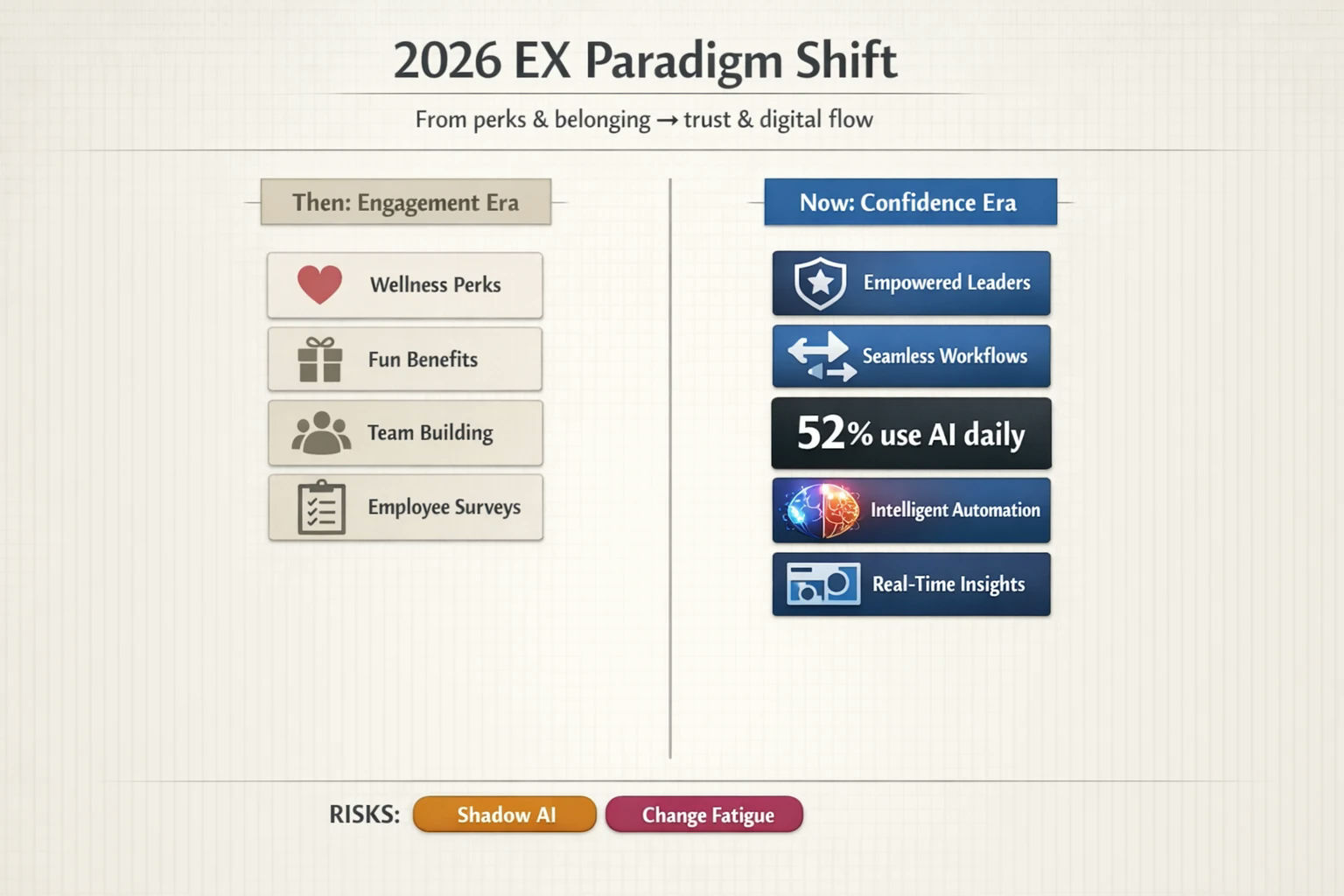
When you are evaluating solutions, you must ask: Does this platform proactively manage AI integration, or does it leave us vulnerable to unsanctioned AI tools and change fatigue?
A framework for modern EX: the 5 C's across the employee lifecycle
The foundational flaw in many legacy EX strategies is treating the employee experience journey as a short-term onboarding checklist that ends after 90 days. A more useful approach is to apply the 5 C's of onboarding, drawn from research by Bauer and others, across the entire employee lifecycle: Compliance, Clarification, Culture, Connection, and Confidence.
Moving beyond the checklist
Instead of a simple "welcome" phase, each pillar applies to every stage of employee experience, not just the first three months.
- Compliance covers the administrative, expense reimbursement, and policy processes that need to be reliable and frictionless throughout someone's time at the organisation, not just on day one.
- Clarification is about employees understanding what is expected of them and where to find the answers they need. An intranet chatbot trained on internal policy documents, for example, can answer routine questions instantly without an HR ticket.
- Culture is reinforced through structured 360-degree recognition that strengthens shared values across departments and locations, well beyond an introductory welcome.
- Connection depends on internal communication that reaches everyone, including deskless and remote employees, in the languages they actually use.
- Confidence comes from feeling supported by personalised benefits, recognised for contributions, and informed about the direction the organisation is heading.

When these pillars work in parallel rather than as a one-off onboarding exercise, employee experience becomes something that sustains engagement rather than something that fades after the first quarter.
Building a 2026 EX maturity model
Once a framework is in place, the next question is how mature the implementation actually is. Most organisations sit somewhere on a spectrum. At one end is a fragmented, reactive setup where surveys, recognition, benefits, and communication all live in separate tools and HR spends hours connecting the dots. At the other end is an integrated, listening-led environment where signals from across the platform feed continuously into how the organisation makes decisions.
From annual surveys to continuous listening
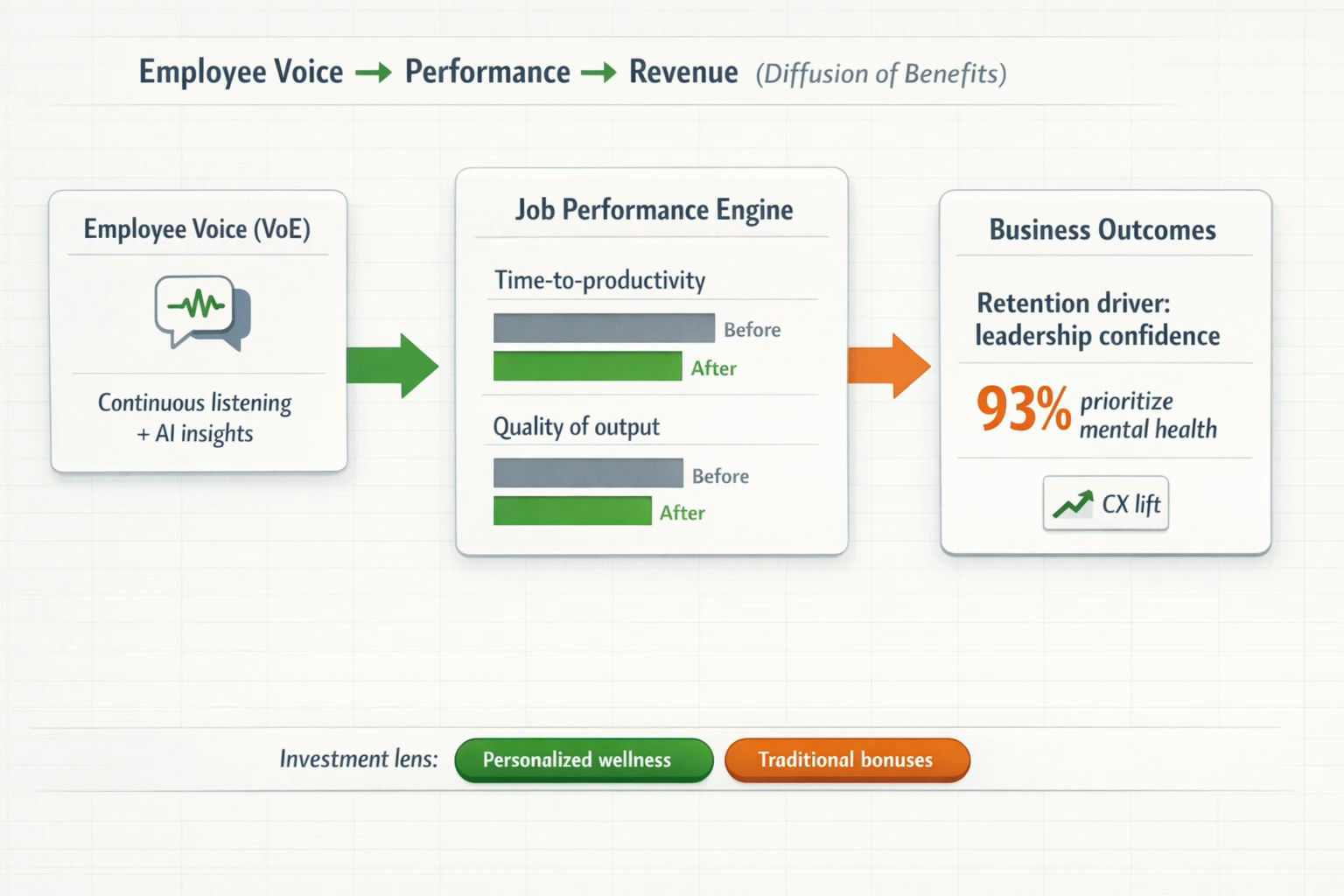
In the middle stages of EX maturity, organisations move away from once-a-year engagement surveys towards a continuous listening approach, often called Voice of Employee. This combines structured pulse surveys with passive signals such as recognition activity, communication engagement, and benefit utilisation. The point is not to track everything; it is to identify two or three indicators that connect directly to the year's people priorities and follow them consistently.
When employees see that feedback influences real decisions, participation tends to increase. The opposite also holds: when surveys go nowhere, employees stop responding, and the data becomes less useful over time.
[cta:cta-2-experience]
Recognition that scales
Recognition is one of the most consistent drivers of engagement, but only when it is easy, visible, and aligned with the values the organisation actually wants to encourage. A 360-degree recognition system that lets colleagues at every level appreciate one another, with personal messages, points, and rewards redeemable in a benefits shop, turns recognition from an occasional management exercise into a continuous cultural signal. Over time, this is what shifts engagement from sentiment to behaviour.

When evaluating platforms, the underlying question is whether surveys, recognition, communication, and benefits sit in a single ecosystem or in separate tools that need to be wired together. Disconnected stacks tend to amplify the change fatigue that organisations are already trying to reduce.
The business case for EX: linking employee experience to commercial outcomes
When a CFO is involved in the conversation, the discussion moves from sentiment to return on investment. Employee experience is sometimes still framed as a soft metric, but the link to commercial outcomes is well established. Gallup's 2024 meta-analysis found that the most engaged teams have 21% lower turnover in high-turnover organisations and 51% lower turnover in low-turnover ones.
The mechanism is straightforward. When employees can communicate clearly, feel recognised for their work, and have access to benefits that match their lives, they spend more time on customer outcomes and less time on internal friction. Lower turnover also means lower recruitment costs, less knowledge loss, and stronger team continuity.
[cta:cta-3-experience]
Personalised benefits as a motivation lever
The shape of incentives has changed. A growing number of organisations are moving away from one-size-fits-all financial bonuses towards benefit models that let employees choose what works for them, including mental health and wellbeing services, gift cards, everyday savings, and learning support. Choice itself is part of what makes the benefit feel valuable; a budget the employee directs themselves often outperforms a generic bonus of the same value on perceived worth.
For HR leaders building a business case, the most useful figures are usually those tied to retention. Replacing an employee typically costs between six months and twice their annual salary, depending on role and seniority. A platform that measurably reduces turnover pays for itself relatively quickly, and integrated EX investment compounds that effect across communication, recognition, and benefits.
Essential criteria for evaluating your EX tech stack
When you start short-listing platforms, the following criteria are the most useful for separating modern solutions from legacy tools that have been re-skinned.
- Integrated vs. fragmented architecture: Does the vendor offer standalone products that each require their own login, or a single platform combining communication, recognition, benefits, and surveys? Integrated platforms reduce administrative overhead and remove the need to wire systems together.
- Personalised benefits: Can the platform manage flexible benefits where employees choose from a wide catalogue of options, including localised options for the markets you operate in? Rigid packages tend to leave a meaningful share of employees underserved.
- Multilingual and distributed reach: If you operate across borders, a multilingual platform is a baseline requirement. Look for an interface available in multiple languages and the ability for HR teams to create content in the languages employees actually use, including for deskless and remote employees who may not have a company email address.
- Predictable, transparent pricing: A clear price per employee per month, based on the modules you actually need, makes the budget easy to plan as headcount changes and avoids surprise charges for add-ons or extra usage.
- Integration with existing HR systems: A modern EX platform should sit next to your HR and payroll systems rather than replacing them. Look for integration via API or structured exports, depending on the systems already in place, so eligibility, joiners, leavers, and benefit changes stay in sync without duplicating effort.
Your next steps: building a connected EX ecosystem
The shift from a fragmented HR setup to a 2026-ready employee experience strategy is one of the more meaningful structural projects an HR team can take on. The pattern across organisations that have made this transition successfully is consistent: piecing together disconnected tools for recognition, benefits management, and internal communications tends to amplify the change fatigue these tools were meant to reduce. Each new login adds friction; each separate dataset adds work for HR.
What works better is a single ecosystem that brings these elements together and treats employees as individuals with their own needs, languages, and circumstances. By evaluating your next platform against the frameworks and maturity models above, you can build a strategy that does more than retain talent. It gives your workforce a working environment that visibly reflects how the organisation thinks about them.
If you would like to see how MELP supports this kind of ecosystem, request a demo or ask for a quote based on the modules you need and the size of your team.
[cta:cta-4-experience]