

If you are evaluating your organisation's HR strategy for 2026, the line between employee experience (EX) and employee engagement (EE) is more than a definitional debate. It is the difference between investing in a survey tool that tells you something is wrong and investing in the underlying systems that prevent that problem in the first place.
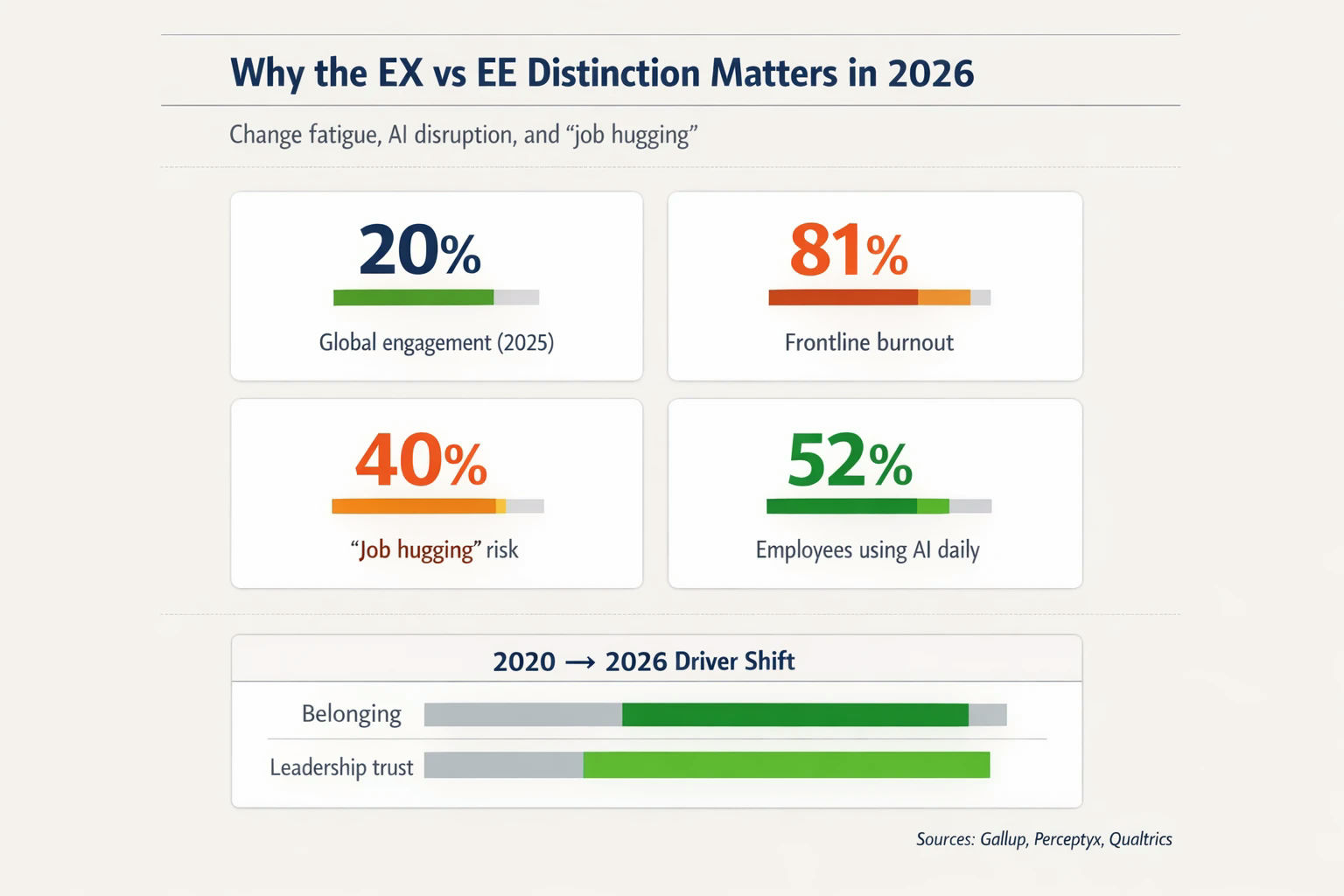
The market backdrop makes the distinction more pressing. Global employee engagement has dropped to 20%, the lowest level in five years, according to Gallup's 2026 State of the Global Workplace Report. Frontline burnout remains widespread, AI is restructuring how routine work gets done, and many employees are staying in roles they would rather leave because of change fatigue and economic uncertainty. In that environment, measuring engagement without addressing the experience producing it is no longer enough.
[cta:cta-1-experience]
This article sets out the practical difference between EX and EE, how the two relate, what to measure on each side, and what the distinction means for the employee experience strategy that you want to build.

The 2026 semantic shift: Experience is what you design, engagement is what you achieve
To put it simply, employee experience is the input. Employee engagement is the outcome.
Employee experience covers the entire journey an individual has with your organisation. It includes the internal communication tools they use, the personalised benefits they choose, the AI-supported workflows that simplify their day, and the physical or remote environments where they work. In 2026, EX has shifted away from surface-level office perks towards reliable communication, consistent employee recognition, and benefits that genuinely fit individual lives.
[cta:cta-2-experience]
Employee engagement is the psychological and behavioural outcome of that experience. It shows up as emotional commitment, willingness to give discretionary effort, and active participation in the culture an organisation is trying to build. You cannot directly mandate engagement; you can only design the experience that produces it.
When HR leaders fail to separate these concepts, they often invest in the wrong solutions, buying engagement survey tools when what they actually need is to fix a fragmented employee experience. The survey then keeps showing the same problem the experience is creating.
How experience produces engagement
The relationship between EX and EE is causal. Three areas account for most of how experience translates into engagement in distributed environments.
Communication and clarity
When employees do not know what is happening in the organisation, what is expected of them, or how to find an answer to a routine policy question, low-level frustration accumulates. The data illustrates the pattern: 97% of employees say communication affects how effectively they complete their tasks each day, while 74% feel they are not receiving all the important news and information. Clear, multilingual internal communication that reaches deskless and remote employees, and an intranet chatbot that answers common questions instantly, removes one of the most consistent sources of disengagement.
Recognition and connection
Recognition is one of the most consistent drivers of engagement, but only when it is easy, visible, and aligned with the values an organisation actually wants to encourage. The numbers back this up: 83.6% of employees say recognition affects their motivation, and 81.9% agree that being recognised improves their engagement. A 360-degree recognition system that lets colleagues at every level appreciate one another, with optional points and rewards, turns recognition from an occasional management exercise into something that runs continuously across teams.
Benefits and choice
A one-size-fits-all benefits package rarely matches the diverse needs of a modern workforce. Personalised benefits, where employees can choose from a wide catalogue of options that suit their actual lives, address a gap that traditional benefit programmes leave open. The choice itself is part of what makes the benefit feel valuable. Centralised access to benefits and clear information about what is available also reduces the confusion that 85% of employees report feeling about their benefits offering.
Measuring what matters: Leading and lagging indicators
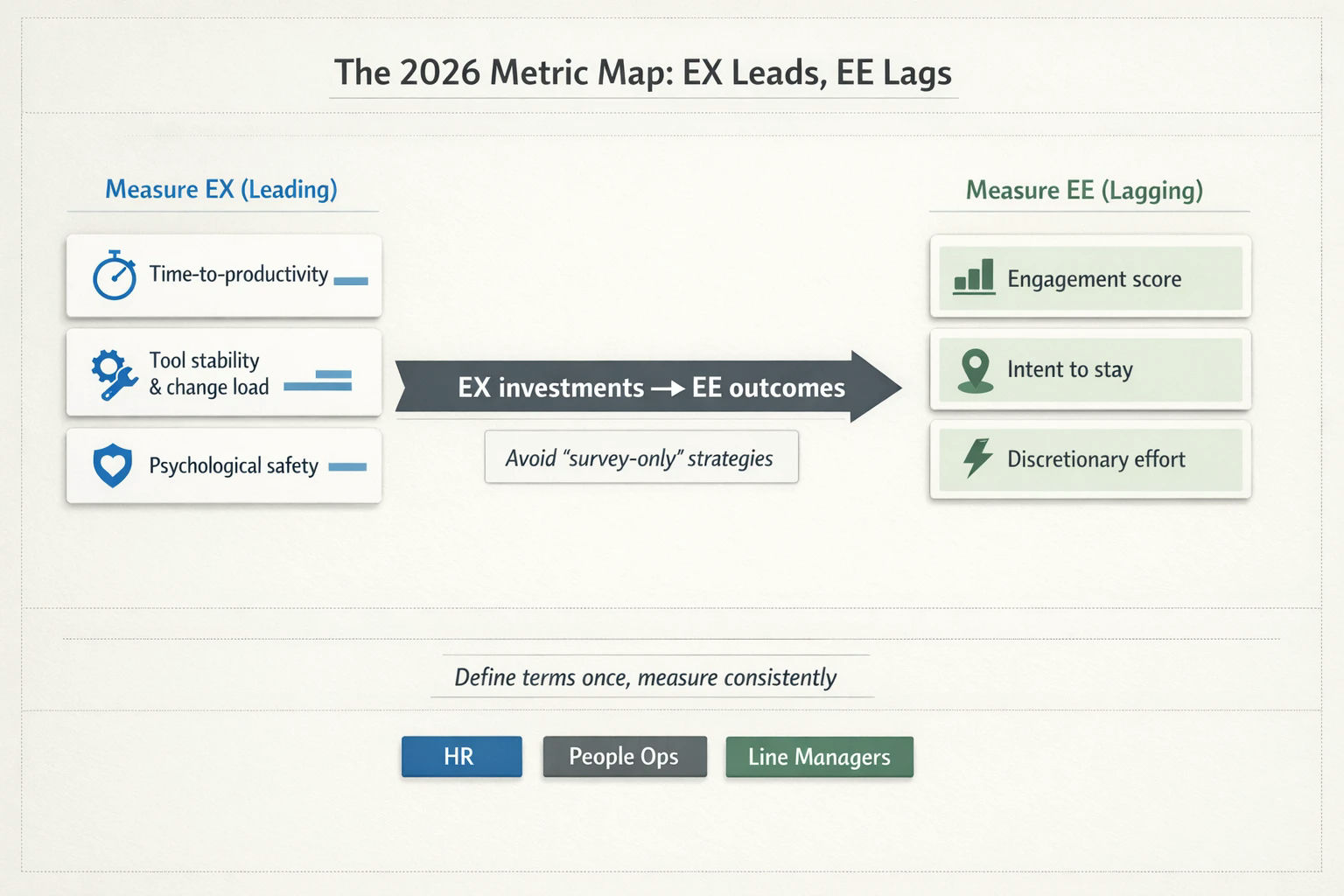
Once you separate EX and EE, measuring them effectively becomes an exercise in tracking leading versus lagging indicators.
EX as leading indicators
Employee experience metrics are leading indicators. They tell you what is happening now, and you can change them in real time. Useful EX indicators include benefit utilisation rates, intranet chatbot usage, time-to-resolution for HR queries, recognition activity, and how widely communications actually reach the workforce. When the experience signals are strong, the foundation underneath engagement is usually sound.
EE as outcome indicators
Employee engagement metrics are lagging indicators. They tell you what the experience produced. Useful EE indicators include retention and absenteeism trends, sentiment from pulse surveys, recognition frequency over time, and qualitative feedback through a feedback inbox. If EX inputs are healthy and EE outputs are not, you have a localised problem to investigate rather than a system-wide one.
The shift in what drives engagement matters here too. Where belonging through workplace perks was historically treated as the central engagement driver, recent research consistently points to clear communication, consistent recognition, and trust in leadership as more important factors in distributed environments. Belonging still matters, but it is no longer the only foundation.
[cta:cta-3-experience]
Linguistic precision: Building credibility through careful HR writing
If you are pushing new engagement initiatives through the C-suite or rolling policy out across the organisation, the language you use carries real weight. Clear writing reinforces credibility and builds trust; ambiguous or inconsistent writing creates friction and erodes both. Two areas tend to make the biggest difference in everyday HR documentation.
The "must" vs. "can" framework
When drafting HR policy, modal verbs determine what is actually required and what is optional. Getting them right makes a policy enforceable rather than merely aspirational.
Must indicates a mandatory action or compliance requirement. "Managers must conduct quarterly wellbeing check-ins" sets a clear expectation.
Can indicates an option or capability. "Employees can use their flexible benefits budget for mental health services" describes an opportunity, not a requirement.
Should sits between the two, indicating a recommendation rather than a hard rule. "Employees should review their benefits annually" guides without compelling.
Blurring these creates ambiguity about what is expected, which confuses employees and makes it harder for managers to apply policy consistently across teams.
Plain language across multilingual communications
The other side of precision is accessibility. HR communication often defaults to legal phrasing or internal jargon, both of which slow employees down and increase the volume of clarifying questions reaching HR. Writing in plain, direct language has practical effects: fewer policy queries in the inbox, faster benefit uptake when eligibility is clear, and more reliable survey responses when questions are unambiguous.
This becomes more important in multilingual organisations, where every layer of jargon adds friction in translation. Content written in plain English tends to translate cleanly into other languages; content packed with HR-speak or English idioms often does not. A platform that supports content creation in multiple languages, combined with a writing style that travels well, gives every part of the workforce equal access to the information they need.

Operationalising the distinction
Understanding the difference between employee experience and employee engagement is the starting point. The next step is putting that understanding into practice across the tools, communication, recognition, and benefits employees interact with every day.
You cannot expect a highly engaged workforce when the underlying experience is fragmented across disconnected tools, inaccessible to global teams, or weighed down by manual administration. Bringing internal communication, flexible benefits, recognition, and AI-supported workflows into a single platform turns high-level strategy into something employees actually feel.
MELP combines internal communication, recognition, and personalised benefits in one platform built to support the experience that produces engagement. Book a demo to walk through it, or check the pricing plans.
[cta:cta-4-experience]