

We are navigating a particular tension in HR this year. Workflow automation and AI-driven HR technology have never been more capable. Yet despite significant investment in digital infrastructure, global employee engagement has stagnated at 20%, the lowest level in five years. Sophisticated tools have not, on their own, translated into a more engaged or connected workforce.
If you are evaluating how to restructure employee experience (EX), the standard playbook of traditional HR lifecycle stages is no longer enough. Employees do not experience their careers in neat HR phases; they experience them as a continuous, emotional, and connected journey. Mapping that journey is what bridges the gap between strategic frameworks at the top of the organisation and the daily workflows that actually shape how people feel about their work.
[cta:cta-1-experience]
Modern organisations are turning to evidence-based employee experience journey mapping for exactly this reason. Done well, the process moves beyond tracking touchpoints to designing an inclusive, accessible environment that supports both engagement and measurable business outcomes.
The 2026 engagement slump: Why traditional models fall short
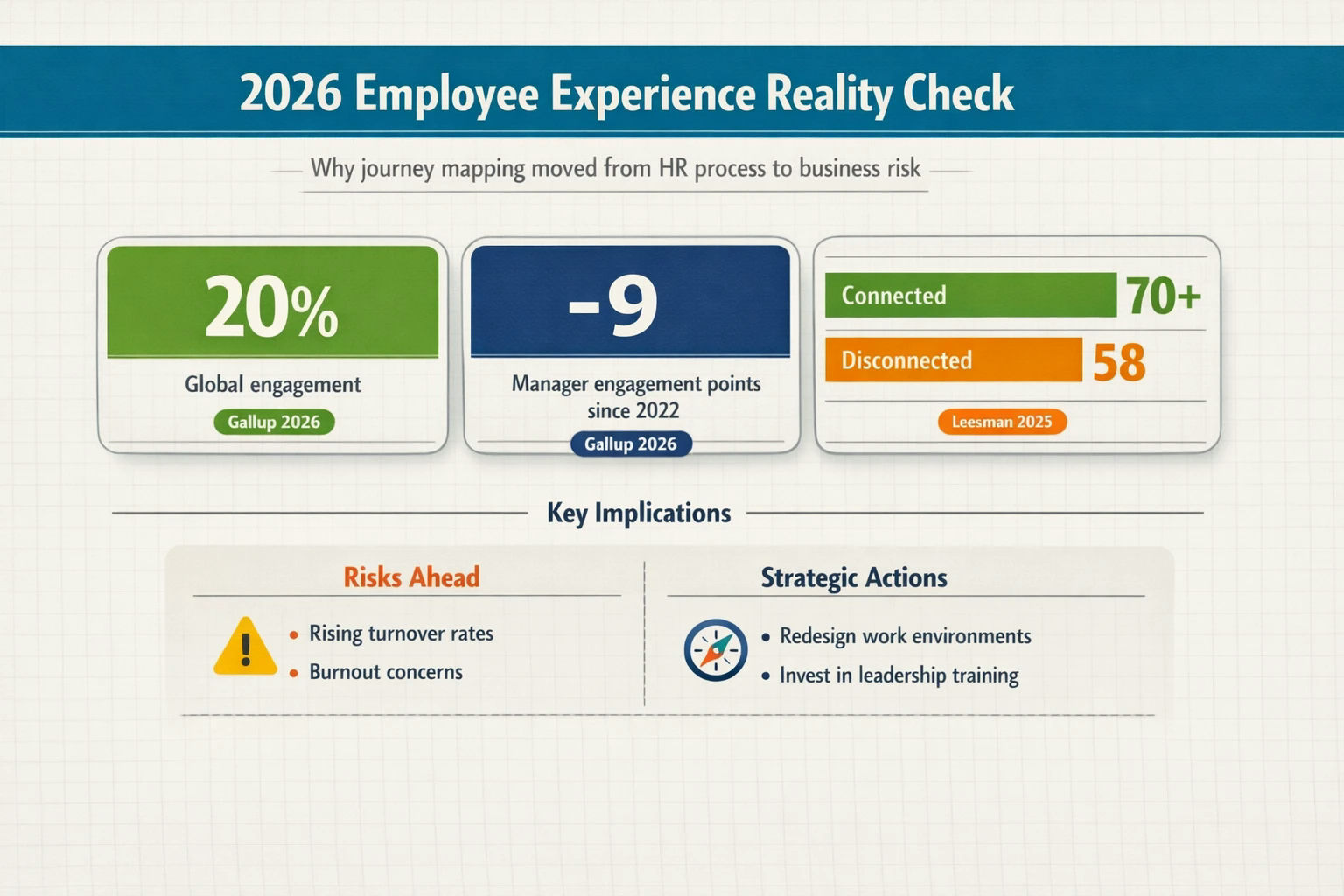
When comparing EX approaches, it helps to start with the data. According to the 2026 Gallup State of the Global Workplace Report, global employee engagement has dropped to 20%, the lowest level since 2020. Manager engagement has fallen further, from 31% in 2022 to 22% in 2025, a nine-point decline Gallup attributes in part to the burden of disconnected tools and fragmented communication processes managers are expected to navigate.
Workplace effectiveness research tells a similar story. Connected hybrid workplaces, where digital and physical experience reinforce each other, consistently outperform disconnected setups on employee effectiveness scores. The gap between the two is where engagement and retention are typically lost.
The market response has split in two unhelpful directions. Some EX approaches offer high-level pedagogical frameworks that are difficult to implement on the ground. Others provide highly technical automation tools that treat employees as a series of tickets to be processed. A useful employee experience strategy for 2026 needs a middle path: a journey that automates the routine while leaving human recognition and connection genuinely human.
Building a hybrid-inclusive journey blueprint
Creating a usable journey map requires looking past the standard stages of recruitment, onboarding, development, and offboarding. A modern blueprint integrates accessibility and hybrid-connection checkpoints across the entire lifecycle, not just at the start.

Building accessibility into the journey, not bolting it on
A common gap in EX design is treating disability and neurodiversity as an HR add-on rather than a core part of the journey itself. In the UK, the Government's Access to Work scheme provides funding and support for adjustments employees may need at work, and applying that same level of accessibility thinking to the journey map ensures benefits, communications, and support are inclusive by design rather than retrofitted.
In practice, this means designing benefit selection, internal communications, and recognition flows so they are accessible across different needs and working patterns from the outset, regardless of whether a specific employee uses an Access to Work grant.
[cta:cta-2-experience]
Manager enablement as a journey layer
Managers carry a disproportionate share of the employee experience, and the Gallup data on manager engagement suggests they are increasingly stretched. A modern journey map builds in support for managers rather than expecting them to interpret vague guidance about "checking in." This includes structured prompts at meaningful milestones, recognition tools quick enough to use without leaving the workflow, and visibility into who on their team has not been recognised or has not engaged with recent communications. The aim is to give managers the support they need to deliver the experience the journey map describes.
Design thinking principles for modern employee experience
Applying design thinking to the employee journey shifts EX from a static document into something that evolves with the organisation. Two principles are particularly useful.
Principle 1: Emotional mapping alongside process mapping
Traditional HR maps track what an employee does. Emotional journey mapping tracks how they feel at each stage. Identifying moments of high anxiety, such as a complex benefits enrolment process or navigating new compliance requirements like the EU Pay Transparency Directive coming into force in 2026, makes it possible to put support in place before friction becomes frustration. A centralised platform where an intranet chatbot can answer policy questions instantly, and where benefit information is clear and accessible, removes one of the most common sources of low-grade anxiety in the daily workday.
Principle 2: Bridging the physical and digital divide
In a workforce spread across regions and languages, physical location should not determine the quality of the experience. Mapping has to account for digital equity. A multilingual platform that delivers corporate news, personalised benefits, and peer-to-peer recognition consistently to an engineer in one location and a retail manager in another is what makes the journey work for the whole workforce rather than only for office-based employees.
Governance: Turning maps into action
A well-designed journey map is only useful if there is governance to execute it. As you finalise your software evaluation, consider how the platform supports the ongoing management of the journeys it underpins.
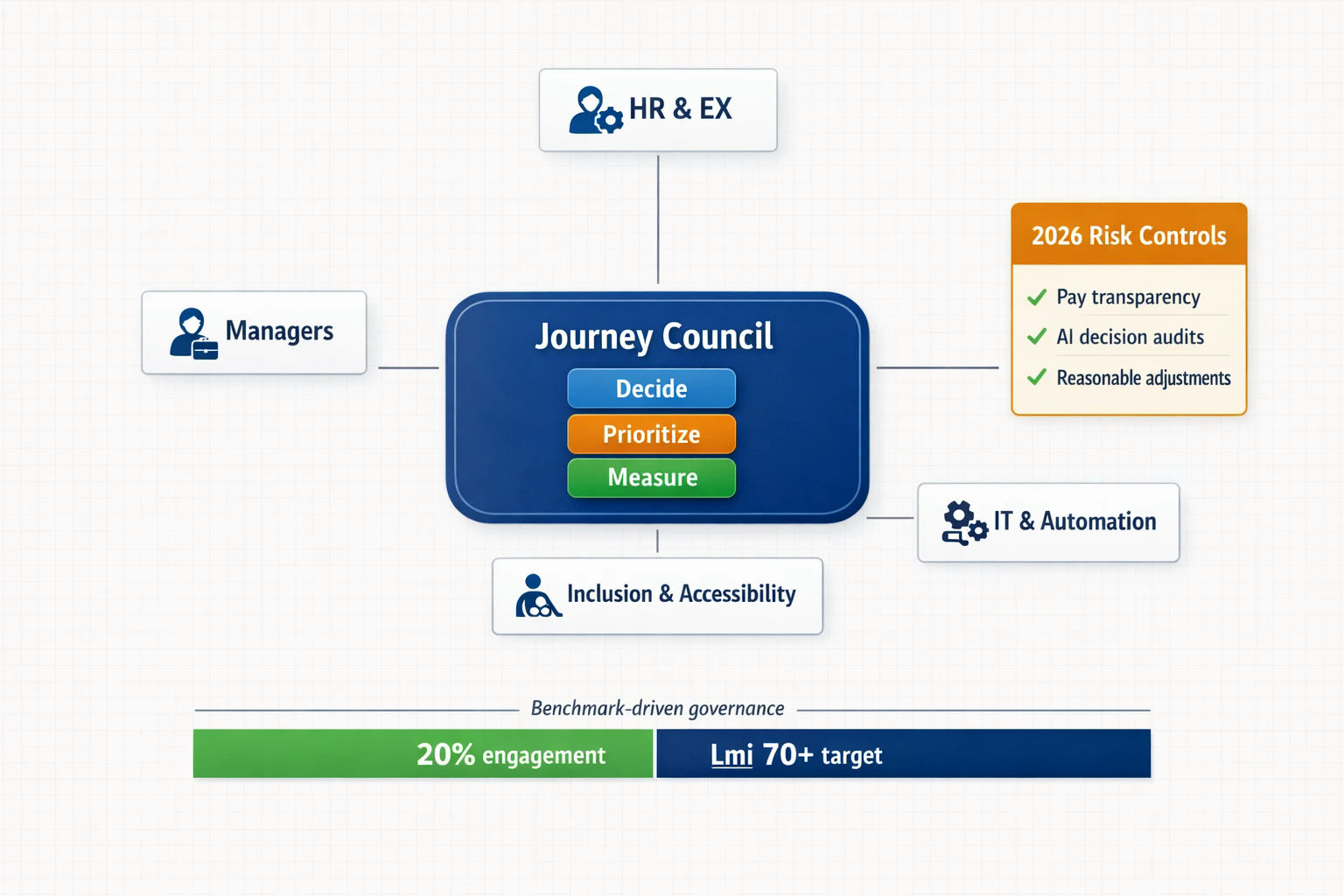
A practical approach is to establish a cross-functional EX governance group that brings together HR, IT, internal communications, and operational leaders, a "journey council". This group reviews more than engagement scores; it monitors how connected the organisation feels, adjusts automated workflows based on feedback, and ensures the journey continues to reflect real working patterns rather than assumed ones.
Regulation is also part of governance. As the EU AI Act rolls out across 2025 and 2026, with the bulk of obligations coming into force in 2026, organisations need to ensure AI-driven touchpoints, from automated expense workflows to pulse surveys, remain transparent and compliant. A connected platform that documents how AI is used, on which data, and for which decisions, makes that easier to defend.
[cta:cta-3-experience]
The business case: Linking journey design to commercial outcomes
If you are preparing a business case for an EX platform upgrade, the financial argument is straightforward. You are not just buying software; you are investing in the systems that shape retention, productivity, and how employees perceive the organisation.
Inclusive EX design has a measurable impact on the bottom line. Research from McKinsey and others consistently shows that organisations investing in inclusion and diverse problem-solving see stronger financial performance over time, driven by improved retention, broader perspectives in decision-making, and reduced administrative overhead.
The differentiator in 2026 is how cleanly an organisation can bring journey design into daily operations. A pay-for-what-you-use platform that brings together internal communication, flexible employee benefits with over 10,000 options, and recognition lets you execute the journey without coordinating across half a dozen vendors. The shift it enables is from HR administering the lifecycle to HR shaping the experience.

Designing a journey that works in 2026
Designing a resilient, inclusive employee journey calls for a platform capable of supporting the realities of the 2026 workplace: distributed teams, multiple languages, varied accessibility needs, and a regulatory environment that asks more of HR than it did three years ago. By bringing communication, employee recognition, and personalised benefits into a single ecosystem, the journey you map on paper becomes the journey your employees actually experience.e
MELP combines internal communication, recognition, and personalised benefits in one platform built for journeys like the ones described above. Book a demo to walk through it, or check the pricing plans.
[cta:cta-4-experience]