

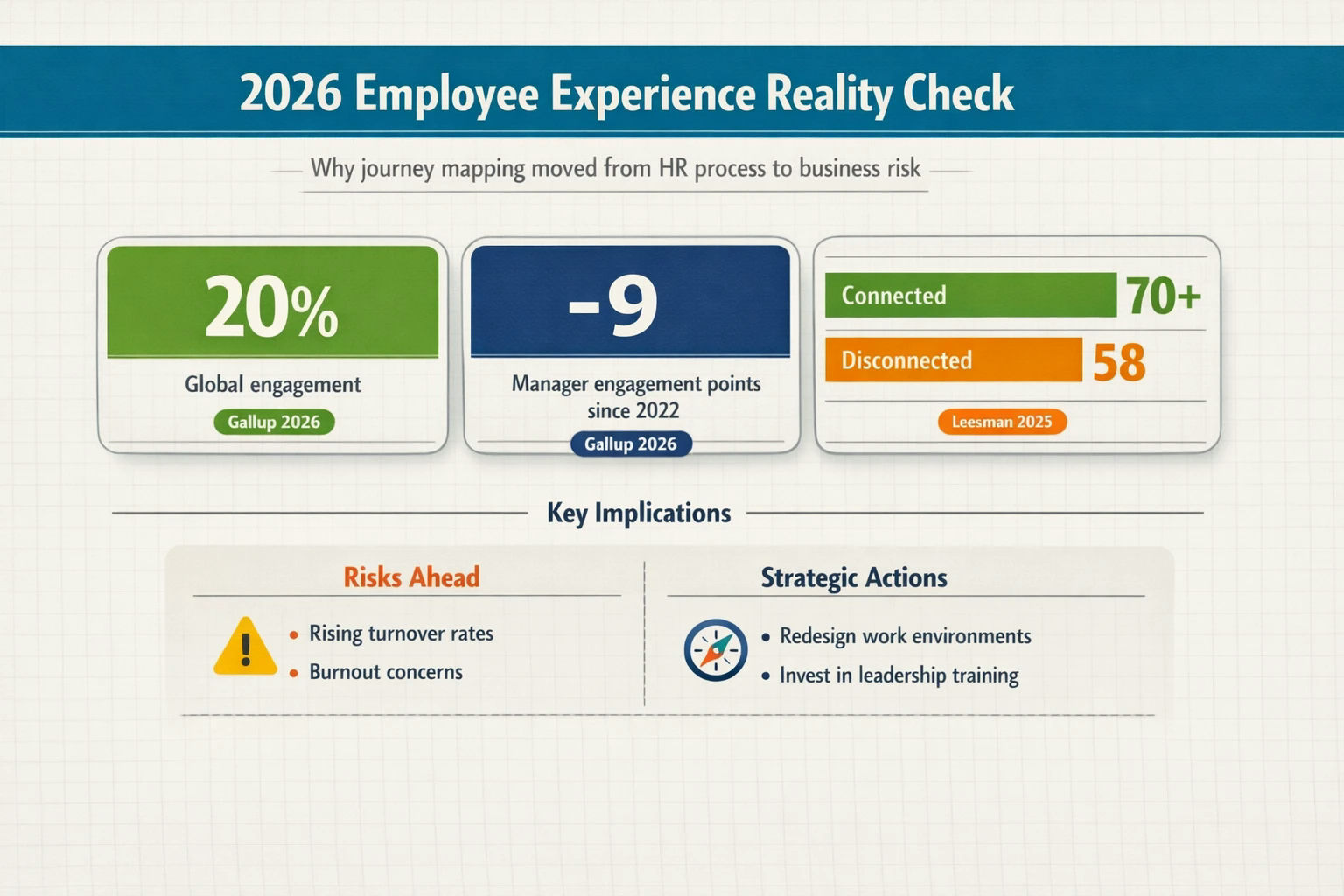
We are navigating a unique paradox in human resources this year. On one hand, workflow automation and AI-driven HR tech have never been more sophisticated. On the other, we are facing a profound "human-centricity crisis." Despite massive investments in digital infrastructure, global employee engagement has stagnated at just 20%.
If you are currently evaluating how to restructure your employee experience (EX), you already know that passive, traditional HR lifecycles are no longer enough. Your workforce doesn't experience their career in siloed HR phases; they experience it as a continuous, emotional, and highly connected journey.
To bridge the gap between high-level HR frameworks and actual daily workflows, modern organizations are turning to evidence-based employee journey mapping. This process moves beyond merely tracking touchpoints to actively designing an inclusive, accessible, and connected environment that drives measurable business success.
The 2026 Engagement Slump: Why Traditional Models Fail
When comparing EX solutions, it is critical to look at the data driving the market. According to the 2026 Gallup State of the Global Workplace Report, not only has overall engagement flatlined, but manager engagement has plummeted by 9 points since 2022. This "Manager Engagement Slump" is the direct result of burdening team leaders with disconnected tools and fragmented communication processes.
Furthermore, workplace effectiveness data from the Leesman Index (Lmi) reveals a stark contrast in hybrid environments. High-performing, "connected" hybrid workplaces boast an average Lmi score of 70+, while disconnected environments languish at 58.
The gap between these scores is where talent is lost. Competitors in the EX space often offer either pedagogical frameworks that are too abstract to implement or highly technical automation tools that treat employees like IT support tickets. The winning strategy for 2026 requires a middle ground: an orchestrated journey that automates the mundane while hyper-personalizing human recognition and connection.
Building the Hybrid-Inclusive Journey Blueprint
Creating a usable journey map requires looking past the standard stages of Recruitment, Onboarding, Development, and Offboarding. A modern blueprint must integrate accessibility and hybrid-connection checkpoints across the entire lifecycle to prevent "one-and-done" EX programs.

The Missing Layer: The AtW Integration
The most glaring blindspot in top-tier EX design today is the failure to map specific disability and neurodiversity touchpoints natively. The UK Government’s Access to Work (AtW) standard shouldn't be an HR add-on or an afterthought; it must be a core journey stage. Integrating AtW-level accessibility directly into your EX mapping ensures that benefits, communication, and support are genuinely inclusive.
The Manager Enablement Layer
Managers are the linchpins of the employee journey. To combat burnout, your map must include specialized toolkits for leaders. Instead of vague directives to "check in," a modern journey map builds in automated prompts for 30-60-90 day inclusive check-ins, seamlessly connecting performance milestones with personalized 360° recognition.
Design Thinking Principles for Modern EX
To transform your EX from a static document into a living ecosystem, you must apply design thinking principles. Organizations that leverage design thinking in HR report a staggering 340% ROI on productivity and a 50% reduction in onboarding friction, according to Forrester and IBM data.
Principle 1: Radical Empathy and Emotional Mapping
Traditional HR maps track what an employee does. Emotional journey mapping tracks how an employee feels. By identifying moments of high anxiety—such as a complex benefits enrollment process or navigating the 2026 EU Pay Transparency compliance updates—you can proactively deploy support. Providing a centralized platform where an AI intranet chatbot can instantly answer policy questions reduces friction and restores confidence.
Principle 2: Bridging the Physical-Digital Divide
In a workforce spread across multiple regions and operating in various languages, physical location should not dictate the quality of the employee experience. Your mapping must account for digital equity. A multilingual platform ensures that corporate news, personalized benefits, and peer-to-peer recognition resonate equally with an engineer in Berlin and a retail manager in Vilnius.
Governance: Moving from Maps to Action
A beautifully designed journey map is useless without the governance to execute it. As you finalize your software evaluation, consider how the platform supports the ongoing management of these journeys.
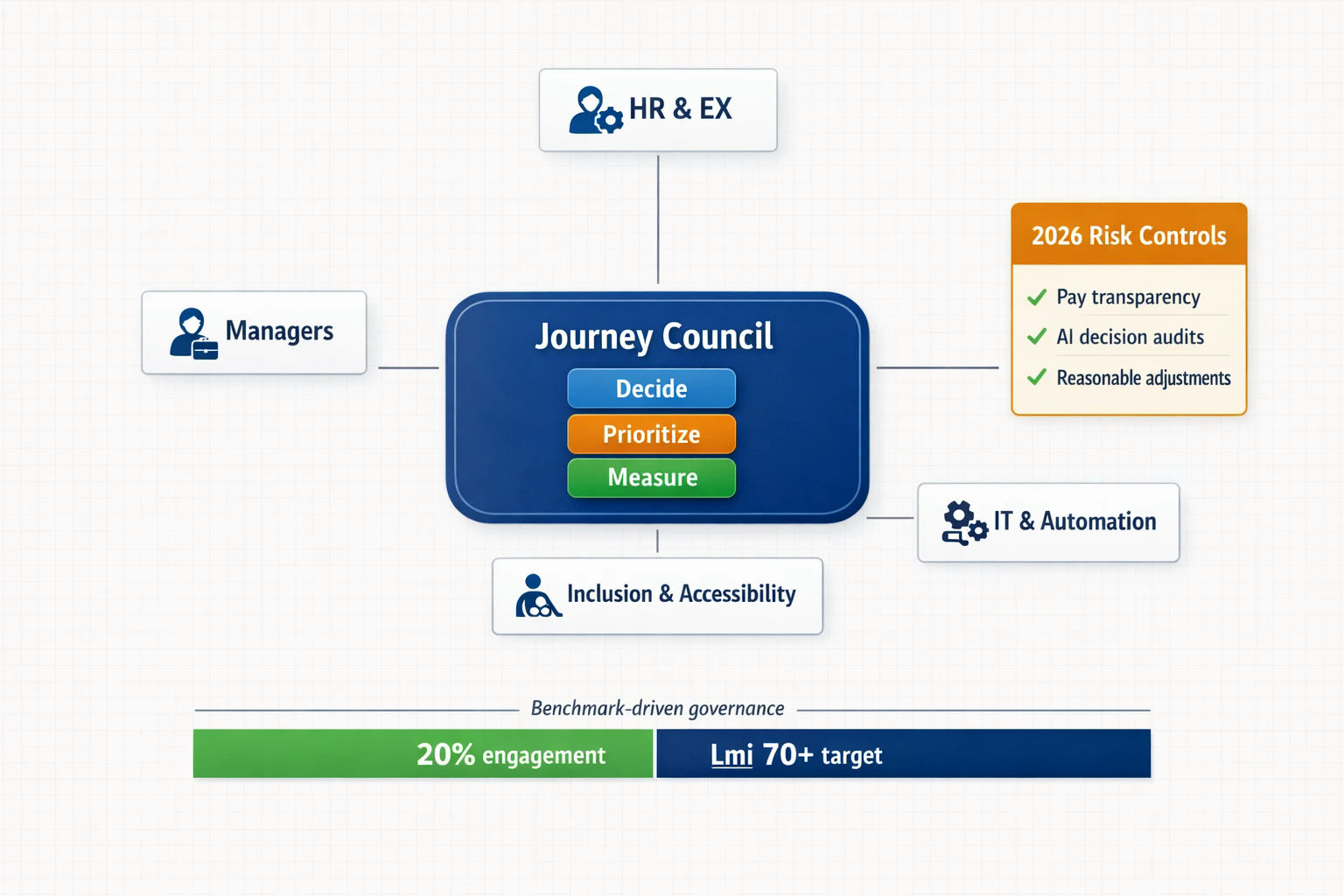
We recommend establishing a "Journey Council"—a cross-functional team of HR, IT, and operational leaders responsible for EX governance. This council doesn't just review engagement scores; they monitor the emotional connectivity of the organization and adjust automated workflows based on real-time feedback.
With rigorous data compliance regulations like the 2026 AI Act in full effect, your Journey Council ensures that all AI-driven touchpoints—from automated expense reimbursements to pulse surveys—remain transparent, compliant, and fundamentally human-centric.
The Business Case: Technical Implementation and ROI
If you are preparing a business case for an EX platform upgrade, the financial narrative is overwhelmingly strong. You aren't just buying software; you are investing in a system that protects your human capital.
Inclusive EX design directly impacts the bottom line. McKinsey data confirms that companies integrating comprehensive accessibility and inclusive design into their journeys see 2.3x higher cash flow per employee. This is driven by drastically improved retention rates, diverse problem-solving capabilities, and a reduction in administrative overhead.

The ultimate differentiator in 2026 is how seamlessly you can integrate these design principles into daily operations. A pay-for-what-you-use platform that natively bundles internal communication, flexible benefits (with over 10,000 choices), and genuine recognition allows you to execute your journey map without juggling six different software vendors. It shifts HR from being administrators of the employee lifecycle to orchestrators of the employee experience.
Designing a resilient, inclusive employee journey requires a platform capable of handling the complexities of the 2026 workplace. By centralizing communication, democratizing recognition, and empowering employees with personalized benefits, you can turn your mapped journey into a daily reality.