


If you are leading HR or employee experience right now, you are likely facing a familiar paradox. Annual employee engagement scores look stable, perhaps even positive, yet turnover stays unpredictable, cross-functional friction is visible, and your CFO is asking for evidence that EX investments are actually moving the business.
The data illustrates the gap. Global engagement has dropped to 20%, the lowest level since 2020, costing the global economy an estimated $10 trillion in lost productivity, according to Gallup's 2026 State of the Global Workplace Report. Frontline burnout remains widespread, and a meaningful share of employees who describe themselves as "engaged" on annual surveys are quietly running on empty. Traditional engagement scores can mask the friction that erodes productivity over time.
The implication is that outcome-based tracking, simply asking whether people are engaged, is no longer enough. What is needed is an environment-based approach that helps you understand why employees are or are not engaged, and what specifically is creating friction in their day. This article walks through the leading EX measurement frameworks, how to build continuous listening without survey fatigue, and how to translate EX data into a business case that holds up in front of an executive team.
[cta:cta-1-experience]
Evaluating the leading EX measurement frameworks
Choosing an EX measurement framework requires balancing scientific validity with operational practicality. A few major methodologies dominate the market, each with distinct strengths and trade-offs.
Gallup Q12
Gallup's Q12 remains the long-standing benchmark for engagement measurement, with comparative data sets across regions and industries. Its core philosophy positions the manager as the primary conduit between strategy and team-level engagement. The model is scientifically robust, but legacy frameworks like this can be slow to incorporate passive sentiment tools or AI-driven analytics, often keeping organisations in a descriptive rather than predictive state.
Qualtrics EX25 and similar enterprise platforms
Qualtrics offers the EX25 holistic framework, treating Experience Management as an enterprise-grade discipline that connects employee, customer, brand, and product experience. The approach offers advanced predictive capabilities but tends to require significant technical setup and ongoing administration. Platforms such as Culture Amp take a more user-friendly route, integrating engagement data with performance data, though they may offer less customisation for highly complex, distributed global organisations.
Continuous listening platforms
Frameworks built around continuous listening, with Perceptyx as a prominent example, capture longitudinal data and combine active surveys with passive signals. They are designed for the way work happens in 2026, but generally require an organisation to have a baseline of data maturity to deploy effectively.
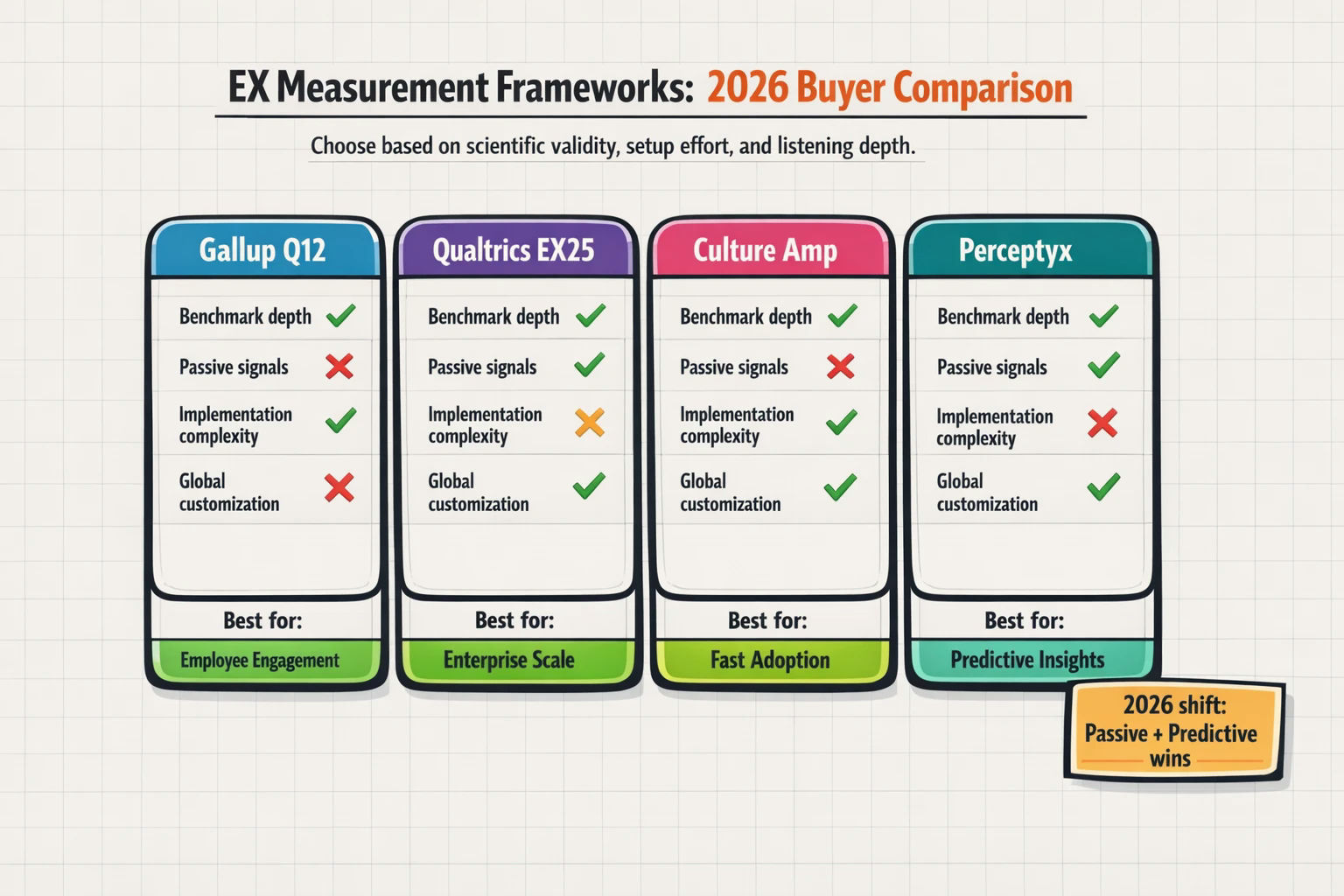
When evaluating these options, the defining question is no longer just how good the survey is. It is how well the framework integrates with the daily operational tools employees actually use. Can it pull data from your internal communications, employee recognition systems, and benefits portals to give you a single view of the employee experience? Platforms that bring these daily interactions together offer a structural advantage when measuring the experience holistically.
A maturity model: From annual surveys to predictive insights
Moving past survey fatigue requires changing how you listen. A useful way to think about it is through four stages of measurement maturity, each addressing the limitations of the one before.
- Descriptive (the survey era): Annual or biannual engagement surveys remain the entry point. Useful for benchmarking, but a lagging indicator: by the time you read the results, the experience that produced them is already months in the past.
- Diagnostic (the pulse era): Monthly or quarterly pulse surveys catch issues faster. Better than annual surveys, but still dependent on active employee input, which eventually leads to fatigue if there are too many touchpoints.
- Continuous (the passive listening era): Active surveys are blended with passive signals from across the platform: system usage, communication engagement, recognition frequency, benefit utilisation. The aim is to triangulate, not replace, qualitative input.
- Predictive (the AI-supported era): Predictive features, where AI surfaces early signals of disengagement or turnover risk, are still developing across the market. They sit at the leading edge of EX measurement and are best treated as roadmap features when evaluating platforms today, rather than current requirements.
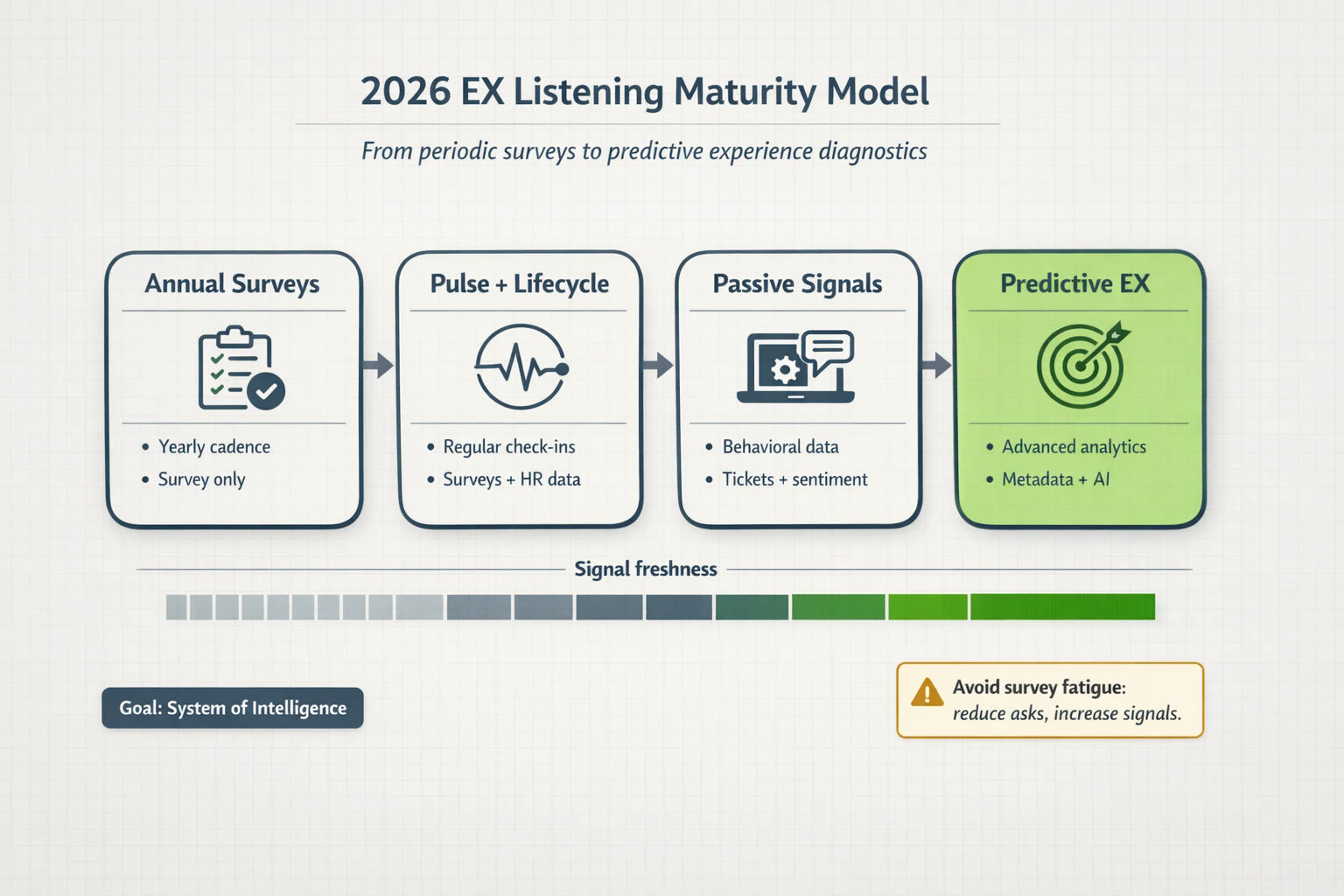
The most useful position to be in is somewhere between continuous and predictive: making active use of passive signals while staying realistic about what AI-supported prediction can deliver right now.
[cta:cta-2-experience]
Passive signals: Measuring the friction surveys miss
Passive listening is the defining feature of modern EX measurement. The practical challenge is implementing it in a way that respects employee privacy rather than creating a surveillance dynamic.
The honest answer is that passive listening should look at metadata and platform engagement, not the content of individual messages. A few signals are particularly useful.
- Recognition activity: How often are employees giving and receiving recognition, and is this consistent across teams? A sudden drop in a specific department's recognition activity is often an early signal of disengagement or burnout, well before it shows up in survey results.
- Benefit utilisation: Are employees actively using their flexible employee benefits? Low engagement here often signals a disconnect between what the organisation offers and what employees actually need. It can also reveal gaps in benefits communication.
- Communication reach: What share of your distributed workforce is actually reading company updates? Tracking this passive signal highlights silos before they fracture organisational alignment, particularly for deskless and multilingual teams.
- Impact of automation on administrative load: Estimates of how AI is changing employee experience are still rough across the market. A practical way to measure it is to track administrative time spent on tasks like expense submission or finding policy answers, then track the change after introducing automation. The reduction in time-to-resolution gives you a tangible measure of impact.
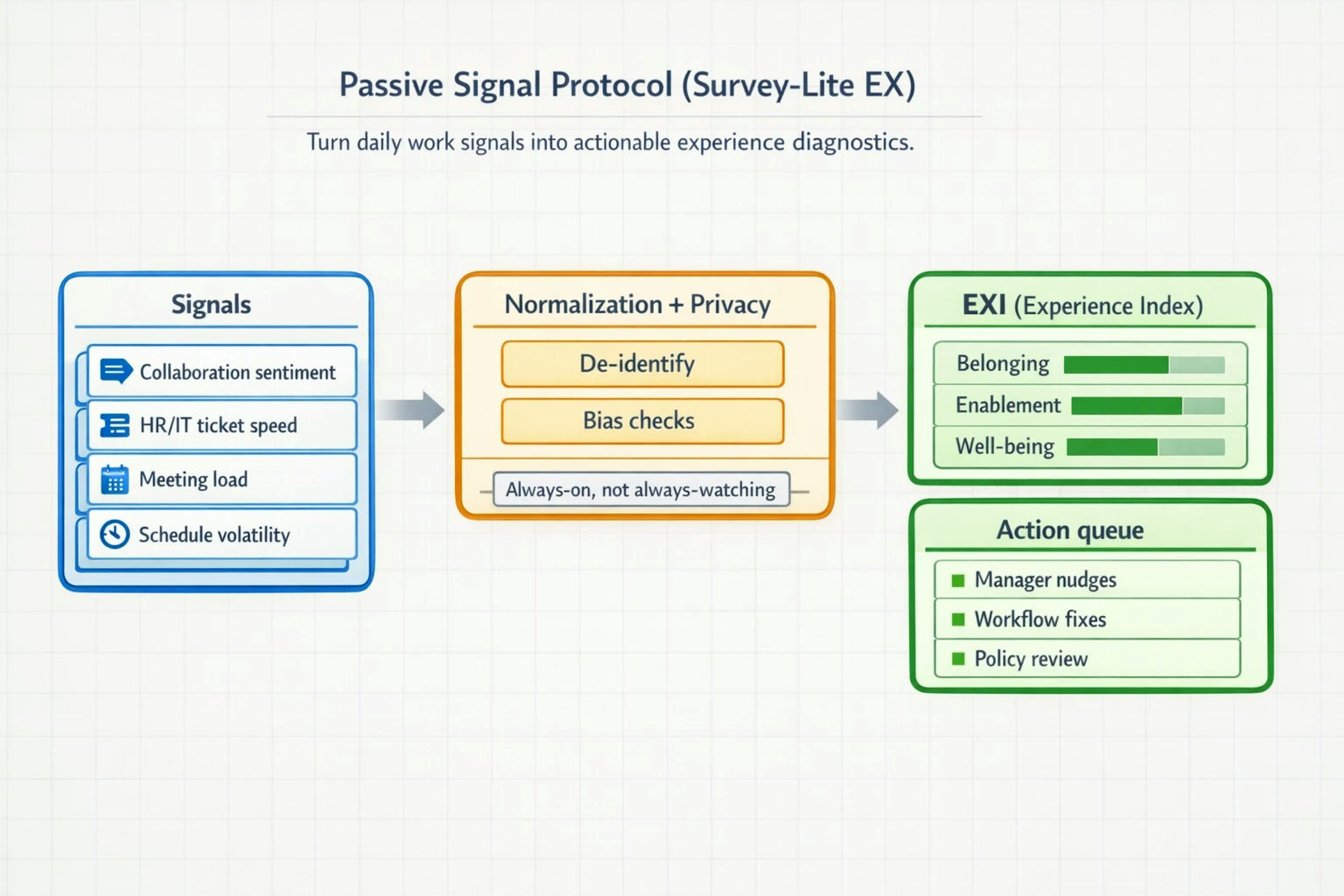
When these signals are captured securely and ethically, they turn invisible friction into actionable data. They allow HR teams to spot systemic bottlenecks rather than waiting for employees to flag exhaustion.
Measuring the full lifecycle
Most frameworks measure the middle of the employee experience journey reasonably well: development, performance, engagement during steady tenure. The under-measured stages tend to be the start and the end, where some of the most consequential moments happen.
Onboarding sets the tone for everything that follows. Capturing how new hires experience their first thirty, sixty, and ninety days, including how clear their role feels, how welcomed they feel, and how usable the tools they have been given are, gives HR an early view of where retention risk is forming.
Offboarding and alumni sentiment
One of the most under-used opportunities in EX measurement is how organisations treat departures. Offboarding is not just an administrative checklist; it is the final touchpoint that shapes whether an employee leaves as a detractor, a neutral, or an advocate.
A useful approach is to measure offboarding the same way you would measure any other journey stage, with a structured exit conversation, sentiment capture, and follow-up tracking. Departing employees who feel respected during their exit are more likely to recommend their former employer to peers, return as boomerang hires, or speak positively in informal networks.
Some organisations extend this further by tracking alumni sentiment over time. Do former employees recommend open roles to their network? Do they speak positively about benefits, culture, and leadership in public forums or to current employees they stay in touch with? Treating offboarding as a long-term relationship moment rather than a termination process changes employer brand outcomes over time, particularly in tight talent markets where referrals and reputation directly affect hiring success.
[cta:cta-3-experience]
The KPI playbook: Translating EX measurement into a business case
HR teams often struggle to defend EX budgets because the conversation gets stuck in sentiment language while the C-suite is thinking in commercial terms. The most useful translations come from connecting EX data to outcomes the rest of the business already tracks.
eNPS vs. a composite EX index
Employee Net Promoter Score (eNPS) is a useful temperature check. It is quick to administer, easy to compare across periods, and gives a directional sense of how employees feel about working at the organisation. The limitation is that it is one-dimensional: a single score that does not tell you why people answered the way they did, and one that is easy to dispute on its own.
A more useful approach is a composite measurement view that combines active survey sentiment (eNPS, pulse data) with passive behavioural data (recognition frequency, internal communication engagement, benefit utilisation) and operational metrics (retention, absenteeism, time-to-resolution for HR queries). Some organisations formalise this as their own EX index, weighted to reflect the priorities of the year. Whether or not you give it a name, the principle is the same: a composite view is harder to argue with than any individual metric, and gives leadership a clearer signal to act on.
Linking EX to customer experience
The strongest version of an EX business case links employee experience directly to customer outcomes. The relationship is well established: organisations with engaged teams see up to 21% higher financial growth and 59% lower employee turnover compared to those with disengaged workforces, both of which contribute to stronger customer experience.
Mapping internal EX data against customer-facing metrics such as Customer Satisfaction (CSAT), Net Promoter Score (NPS), or customer retention rates makes this connection visible. When recognition activity, internal communication reach, and benefit utilisation move in the same direction as customer satisfaction or retention, the case for EX investment becomes harder to dismiss as a soft cost.
Replacing an employee typically costs between six months and twice their annual salary, depending on role and seniority. A measurement framework that catches disengagement early enough to prevent attrition often pays for itself within the first year, and that is before accounting for the customer outcomes that strong EX produces.

Bringing measurement and experience together
The organisations getting the most out of EX measurement in 2026 are not the ones with the longest surveys. They are the ones using integrated platforms where communication, recognition, and benefits all sit in the same place, generating the passive signals that make continuous listening practical without adding more questions to ask.
When employees have a single, mobile-first space to read company updates, recognise colleagues, manage their benefits, and submit expenses, the measurement happens almost as a by-product. The signals you need are already in the system; the question is whether your platform makes them visible and usable.
MELP combines internal communication, recognition, and personalised benefits in one platform built to make this kind of measurement straightforward. Book a demo to walk through it, or check the pricing plans.
[cta:cta-4-experience]