

If you are currently mapping out your organizational strategy for the upcoming budget cycle, you have likely realized that the traditional employee experience playbook is broken. Just a few years ago, HR leaders focused heavily on "emotional engagement"—trying to foster a sense of belonging through generic office perks and surface-level initiatives.
Today, in 2026, the landscape has fundamentally shifted. Your workforce doesn't want another pizza Friday; they want a frictionless environment where they have the tools to do their best work and the autonomy to choose the benefits that actually matter to them.
As a decision-maker evaluating how to structure or upgrade your employee experience (EX) tech stack, you are no longer just buying an HR tool. You are architecting a performance engine. This guide serves as your strategic blueprint for evaluating, designing, and implementing a modern EX framework that aligns directly with your C-suite’s business objectives.
The 2026 EX Paradigm Shift: From Emotional Engagement to Functional Confidence
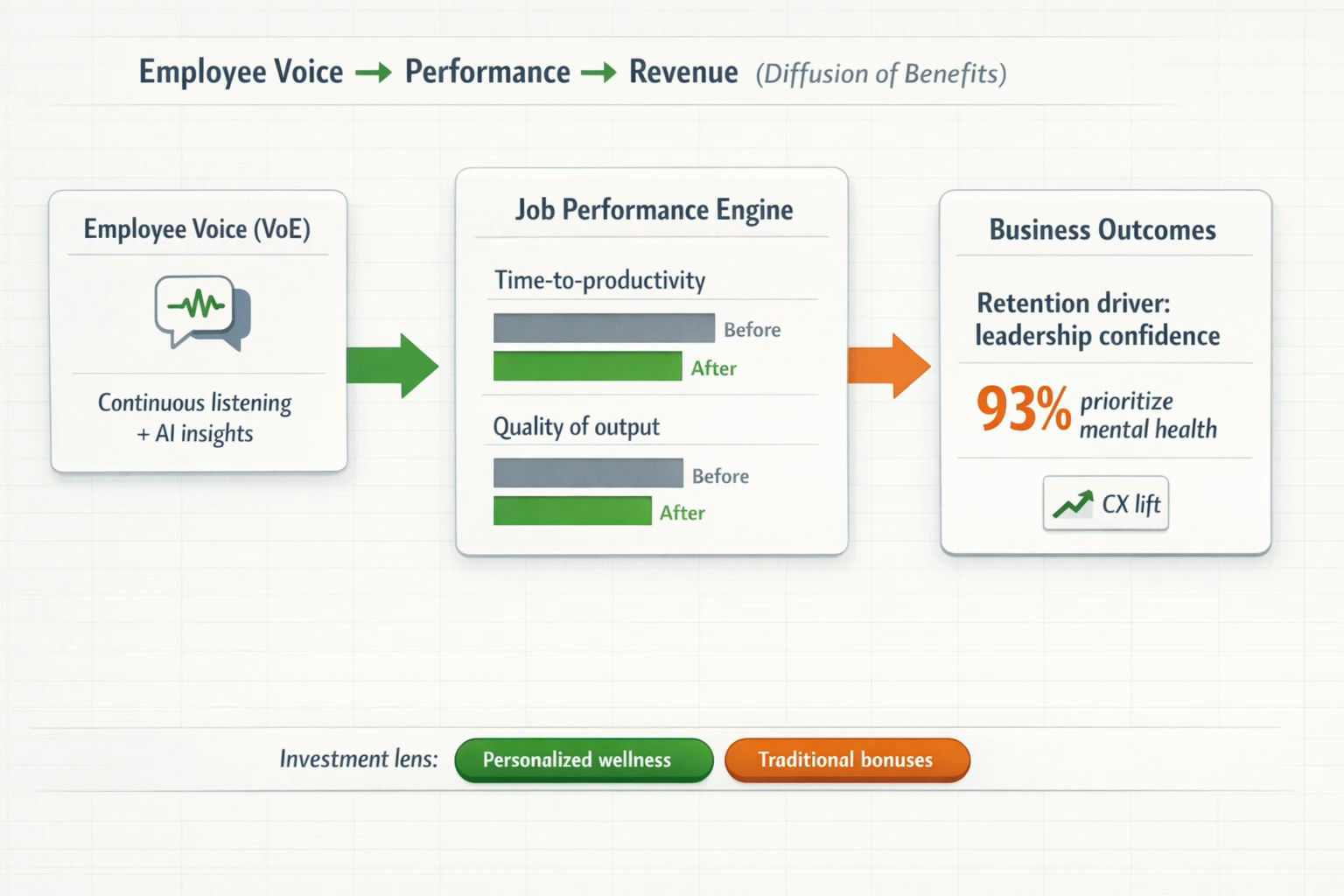
We have crossed a critical threshold. Recent benchmark data from Perceptyx and Qualtrics reveals that leadership confidence and effective change management have officially replaced "feeling valued" as the number one driver of employee retention.
We refer to this new standard as functional confidence. Employees want to trust their leadership's vision, and they expect absolute "digital flow"—meaning their internal communication, benefit selection, and daily workflows happen in a centralized, intuitive ecosystem.
Furthermore, we cannot discuss the modern workplace without addressing the most significant behavioral shift of our time: 52% of employees now use AI daily. Your modern EX strategy must account for Human-AI Co-experience. It is no longer about managing AI as a disparate tool, but rather integrating it as a core component of how your employees communicate, find information, and navigate their workday.
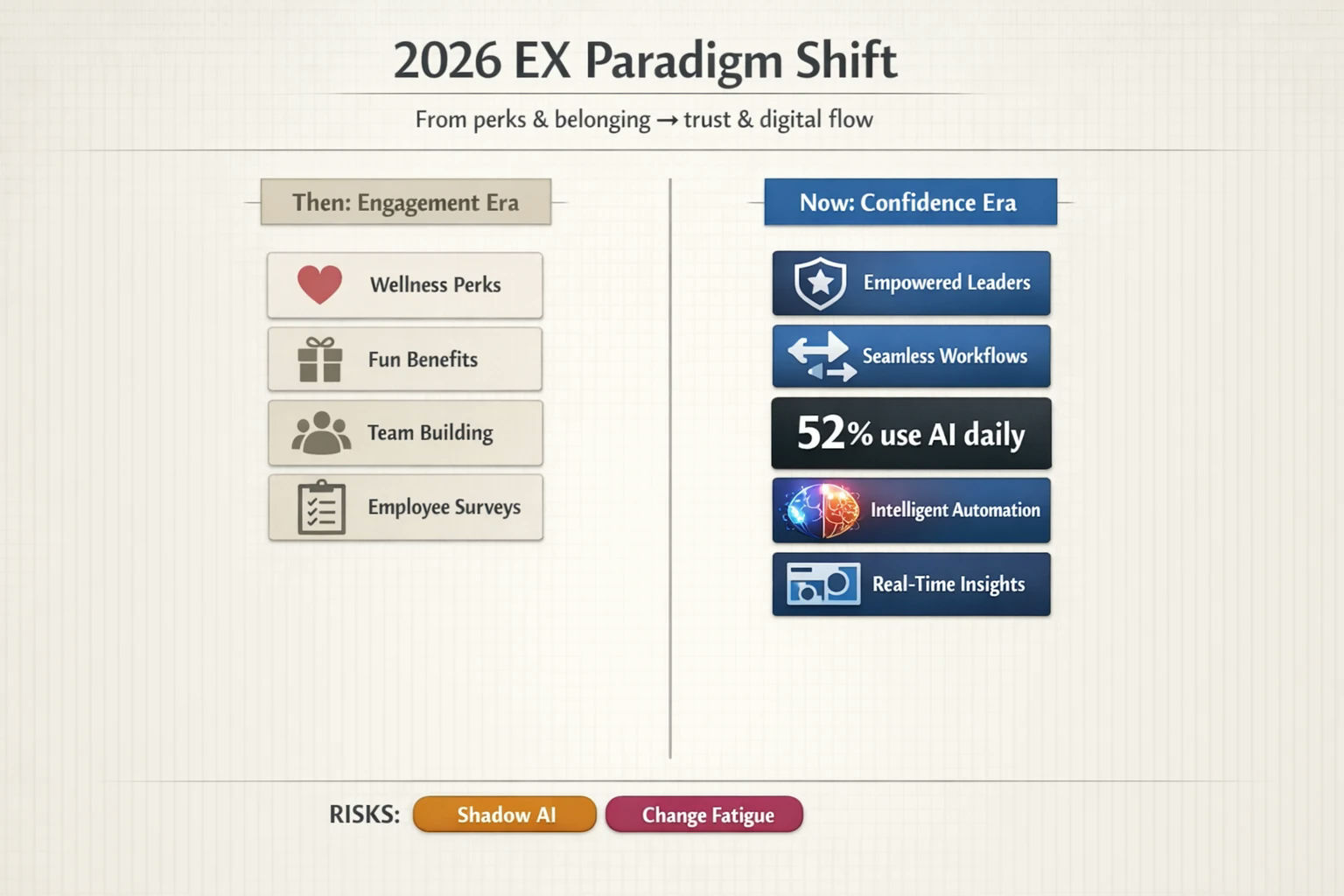
When you are evaluating solutions, you must ask: Does this platform proactively manage AI integration, or does it leave us vulnerable to "Shadow AI" and change fatigue?
Architecting the Framework: The 5x5 High-Performance Matrix
The foundational flaw in many legacy EX strategies is treating the employee journey as a short-term onboarding checklist that ends after 90 days. To build a robust framework, progressive organizations are adopting the 5x5 High-Performance Matrix, which merges the five standard stages of onboarding with the 5 C’s: Compliance, Clarification, Culture, Connection, and Confidence.
Moving Beyond the Checklist
Instead of a simple "welcome" phase, every stage of the employee lifecycle must map to these strategic pillars:
- Compliance: Are the administrative, expense reimbursement, and policy protocols automated and frictionless?
- Clarification: Do employees understand their roles, and do they have instant access to an AI intranet chatbot to answer their operational questions?
- Culture: Is there a 360° recognition system in place that actively strengthens a culture of appreciation across departments and borders?
- Connection: Can a multilingual internal communication platform keep everyone aligned, regardless of whether they speak English, Lithuanian, Latvian, or German?
- Confidence: Do employees feel empowered by their personalized benefits and trust the leadership's direction?

By evaluating your strategy against this matrix, you transition your EX from a reactive HR function into a proactive performance system.
Building Your 2026 EX Maturity Model
As you compare different methodologies, you need to assess your organization's current maturity level. The goal is to move from a fragmented, reactive state into an AI-optimized, continuous listening environment.
Architecting the "Employee Voice" Ecosystem
In the mid-stages of EX maturity, organizations transition from annual surveys to Continuous Listening (Voice of Employee, or VoE). This means utilizing data-driven decision-making tools to understand what your team actually needs right now.
When employees feel heard, they evolve into advocates. Implementing a Gamified Advocacy Roadmap—where you turn the employee voice into a brand engine using leaderboards and seamless recognition rewards—creates a self-sustaining cycle of motivation.

When assessing platforms, prioritize those that offer a single, unified ecosystem. Disconnected tools for surveys, rewards, and internal communications only breed the very change fatigue you are trying to eliminate.
The Business Case for EX: Calculating ROI and the "Diffusion of Benefits"
When you take this strategy to your CFO, the conversation cannot be about "making people happy." It must be about the Diffusion of Benefits (Spillover ROI)—the direct, measurable link between your employee experience and your customer experience (CX).
Mass Personalization vs. Traditional Bonuses
We are seeing a massive shift in modern incentive approaches. According to recent Alight data, 93% of high-performing organizations now prioritize mental health and personalized well-being as core incentives over traditional, one-size-fits-all financial bonuses.
Employees want agency. A strategy that empowers them to choose from thousands of tailored benefit options dynamically impacts their job satisfaction.
The ROI of Gamified Advocacy
Furthermore, the spillover effect into marketing and revenue is quantifiable. Gamified internal advocacy programs routinely generate up to 8x higher content engagement externally. When your employees are genuinely recognized and empowered through an all-in-one platform, they naturally become your most credible brand ambassadors.
Essential Comparison Criteria: Evaluating Your EX Tech Stack
As you short-list potential software partners to bring this 2026 framework to life, use these specific criteria to separate legacy tools from modern solutions:
- Siloed vs. Holistic Architecture: Does the vendor offer standalone products that require multiple logins, or do they provide an all-in-one platform integrating communication, recognition, benefits, and surveys? Holistic solutions drastically reduce administrative friction.
- Mass Personalization of Benefits: Can the platform manage flexible benefit plans tailored to individual needs? Look for solutions offering extensive, localized benefit options rather than rigid packages.
- Global Reach with Local Resonance: If you are operating across borders, multilingual support is non-negotiable. Your platform must allow you to create and distribute content seamlessly in multiple languages so no team member is left in the dark.
- Pay-For-What-You-Use Flexibility: Protect your budget. Modern providers offer convenient budget management with clear, consumption-based invoicing rather than bloated enterprise lock-ins.
- Ecosystem Integration: The platform must easily sync with your existing HRIS (like BambooHR or Runa) to ensure seamless data flow.
Your Next Steps: Building a Cohesive EX Ecosystem
The transition from a fractured, legacy HR approach to a 2026-ready Employee Experience strategy requires decisive action. The data is clear: piecing together disconnected tools for recognition, benefits management, and internal communications will only lead to change fatigue and disjointed team dynamics.
To win in today's market, you need a centralized ecosystem that champions functional confidence, embraces the AI revolution, and treats your employees as distinct individuals with unique needs. By evaluating your next EX platform against the frameworks and maturity models outlined above, you can confidently architect a strategy that doesn't just retain your best talent, but actively drives your business forward.