
Your most valuable assets are your people. Every evening, they walk out the door.
Whether they come back tomorrow, and how hard they work, shows up in your P&L.
How do you recognise who is who?
Engaged doesn't just mean happy; it means they care about the result. Tap a battery and see how each group behaves. Source: Gallup, Q12 Meta-Analysis, 11th edition (2024)
Engaged teams sell more. And earn more.
The most engaged teams bring in 18% more sales and 23% more profit, while costs fall on almost every line. Engagement pays off.
Is this just marketing?
Fair question. The figures come from the largest study of its kind, run by Gallup.
Gallup Q12 Meta-Analysis, 11th edition (2024). The figures above compare the most engaged teams with the least engaged. Where annual employee turnover is above 40%, the turnover difference is 21% instead of 51%.All figures are median differences across Gallup's clients, not a guarantee for one company.Source: Gallup, Q12 Meta-Analysis, 11th edition (2024)Read the study ↗
Don't take Gallup's word for it. Ask our clients.
More than 70,000 people use MELP at work every day.
4.8/5 on Capterra from 22 verified reviews“The colleague recognition program brings a lot of good emotions and really helps people feel valued.”
“Better than expected! … saving our management costs and efforts.”
“People are always looking for proof of how much the company cares about them. When they get that proof, they tend to be more loyal and don’t look for alternatives elsewhere.”
“We enjoy the simplicity of administration and the automation of certain processes.”
The most engaged teams are 5 times more likely to beat the average.
Gallup took 100 of the least engaged teams and 100 of the most engaged, and counted how many beat the average team in their company.
Almost 5 times as many winning teams. Source: Gallup, Q12 Meta-Analysis, 11th edition (2024)
What your leavers cost you
Replacing one employee costs half to twice their annual salary. Source: Gallup, This Fixable Problem Costs U.S. Businesses $1 Trillion (U.S. data)
Specialists and managers usually cost 1 to 2 times their annual salary to replace. Source: Gallup, This Fixable Problem Costs U.S. Businesses $1 Trillion (U.S. data)
How MELP moves these numbers
Gallup measures engagement by asking whether people's basic needs at work are met. MELP covers the ones a company can act on every week, in one app on every employee's phone. Source: Gallup, Q12 Meta-Analysis, 11th edition (2024)
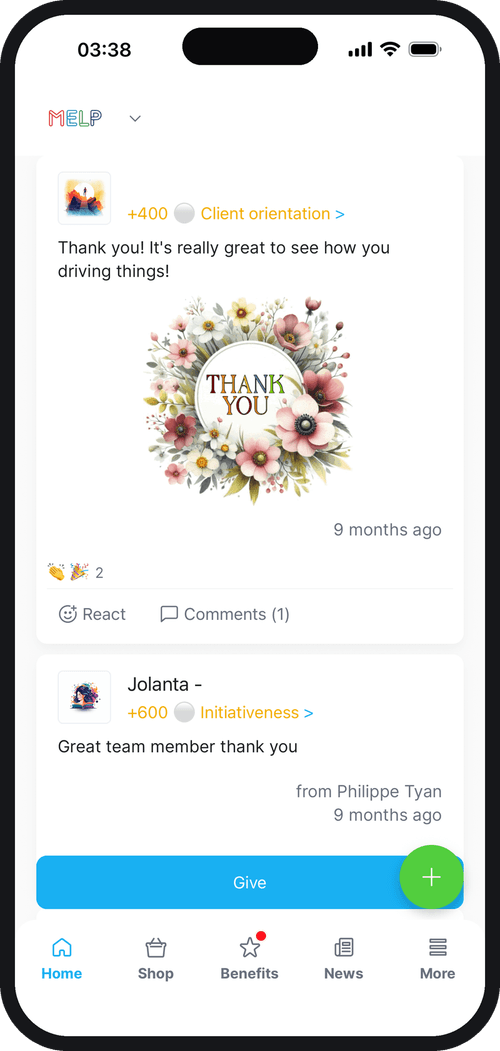
Recognition: how it works
- Anyone can thank a colleague in a few taps.
- A thank-you can carry points, which people spend on benefits they choose.
- Recognition is visible to the team, so good work gets noticed beyond one manager.
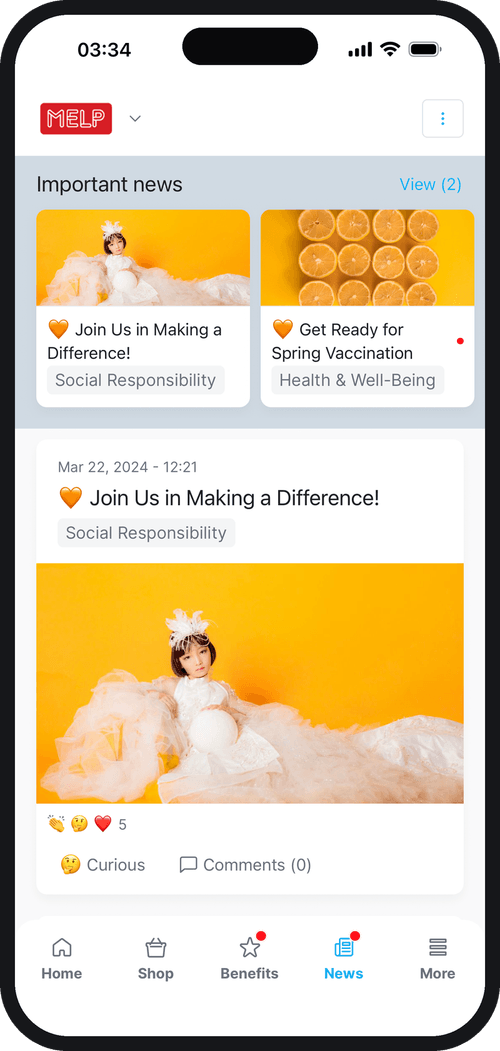
Communication: how it works
- Post news and announcements once. They reach every employee's phone.
- The app translates company content, so each person reads it in their own language.
- Frontline staff get the same information as the office.
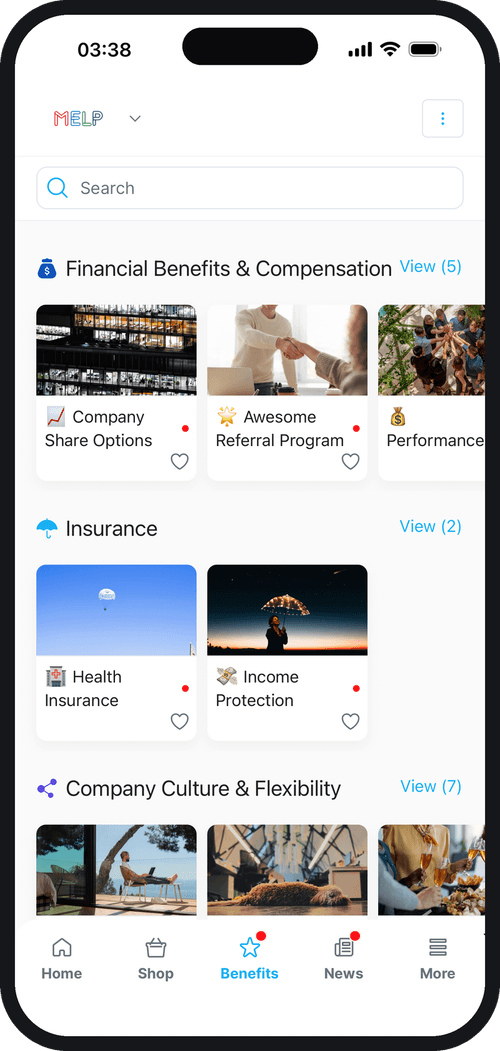
Flexible benefits: how it works
- You set the budget and the rules.
- Each person chooses from 10,000+ benefits, from sport and health to extra days off.
- 850+ discounts on everyday brands come on top.
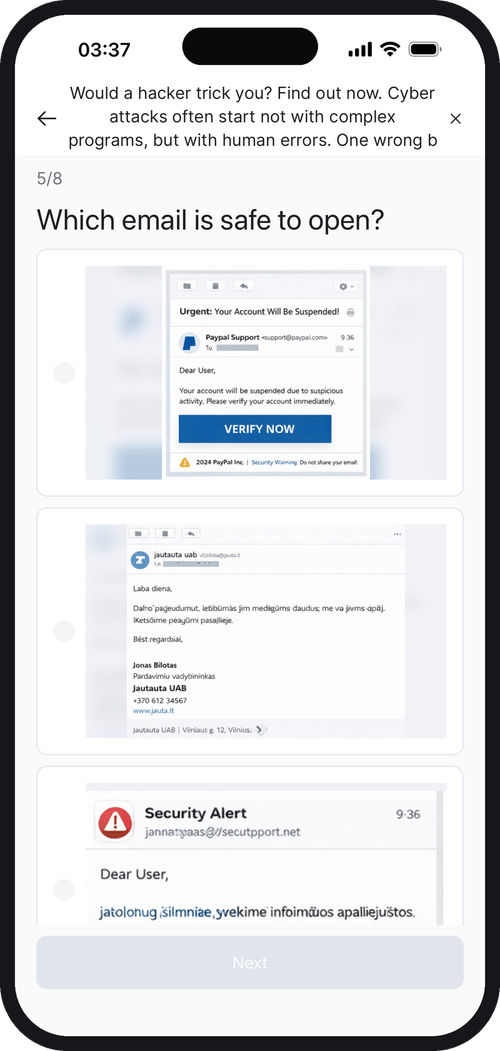
Training: how it works
- Turn onboarding, compliance and know-how into short trainings with tests.
- People take them on their phone, in their own time.
- Finishing a training earns a reward.
See it with your own people and numbers.A short walkthrough of MELP set up for a company like yours.
Show me what it is worth for usHow 37 European countries compare
Share of employees who are engaged at work. Europe is the least engaged region in the world.
Questions leaders ask
Short answers for CEOs, CFOs and HR leaders.
What is the ROI of employee engagement?
Gallup's meta-analysis of 183,806 teams compares the most engaged quarter of teams with the least engaged. The most engaged are 23% more profitable, sell 18% more and keep 10% more customers loyal, with 78% less absenteeism and 51% less turnover in low-turnover organisations. To turn that into your own ROI, put a cautious number on two things you can already measure, turnover and absence, and compare it with the yearly cost of what you invest. Our turnover cost calculator, linked above, does the turnover part.
How much does employee disengagement cost a company?
Gallup estimates that low engagement cost the world economy about $10 trillion in lost productivity in 2025, around 9% of global GDP. Inside one company, the cost shows up in places finance already tracks: replacing a leaver costs half to twice their yearly salary, absent days need cover, and errors, safety incidents and lost customers all carry a price. Our turnover cost calculator, linked above, shows what your leavers cost.
Does employee engagement really increase profitability, or just correlate with it?
The studies show a strong and repeated link, not a laboratory proof. Gallup has repeated its analysis 11 times, across 53 industries and 90 countries, and the gap between the most and least engaged teams appears every time. Engagement is one of several drivers of profit; the honest reading is that a company with more engaged teams has much better odds, not a guaranteed result.
What percentage of employees are engaged at work in Europe?
Only 12% of employees in Europe are engaged, against 20% worldwide, according to Gallup's State of the Global Workplace 2026. Globally, 20% are engaged, 64% are not engaged and 16% are actively disengaged. Levels vary widely by country, from single digits to above 30%; the ranking above shows all 37 European countries.
What is the difference between not engaged and actively disengaged employees?
Not engaged employees do what is asked and little more: they give their time, but not their energy. Actively disengaged employees are unhappy and show it; they slow others down, side with complaints and resist change. Both cost money, but the actively disengaged cost more because they also drag down the people around them.
Which KPIs show whether employee engagement is working?
Four numbers, by team, every quarter: staff turnover, sick days, revenue per employee and customer churn. Add a two-minute engagement pulse survey next to them. If engagement goes up and those numbers improve, you have the proof in your own data.
How do I measure employee engagement?
Ask a small set of consistent questions about what people need to do good work, such as clear expectations, recognition, someone who cares and a chance to grow, and repeat them at least twice a year. Report results by team, not just company-wide, because engagement is local to each manager. Combine survey results with behaviour you can see, such as how often people use recognition, read company news or take up training.
How do I build a business case for employee engagement for the CFO or board?
Start with what is already counted: the cost of last year's leavers, absence days and hiring. Use the low end of every range, so the case survives challenge. Show the investment next to one or two measurable targets, for example a lower turnover rate, and agree how you will check progress each quarter. A CFO trusts a small, conservative number that is tracked more than a large estimate that is not.
Can an app like MELP increase employee engagement?
An app cannot replace good managers, and Gallup finds that manager engagement itself fell to 22% globally in 2025. What an app can do is make the basics happen every week, for every employee, including those without a desk: recognition, company news, flexible benefits and training in one place. It also gives managers and HR visible data on what is used.
Is MELP suitable for our company size?
MELP fits best in organisations with at least one HR manager, and the value usually starts around 100 employees. Some clients with 30 to 50 people use it too, typically when staff are spread across several locations or when recognition is the main goal. Larger clients run it across thousands of employees.
How much does MELP cost?
Pricing is based on a quote, because it depends mainly on the number of employees and on which parts of MELP you use, such as recognition, communication, benefits or training. Book a demo and you get a price for your own company and set-up.
Where do the figures on this page come from?
All figures come from published research, not from MELP: Gallup Q12 Meta-Analysis, 11th edition (2024) for the effects on profit, sales and costs; Gallup State of the Global Workplace 2026 and its country data for engagement by country; and Gallup's research on employee turnover for the cost of replacing a leaver.